Arizona Roofing Code for Homeowners and Contractors
Arizona roofing work is governed by the International Building Code (IBC) for commercial structures, the International Residential Code (IRC) for one- and two-family homes, and the International Fire Code (IFC) for fire-related requirements. None of these are adopted statewide in a single uniform edition. Instead, each city, county, or local Authority Having Jurisdiction (AHJ) adopts its own edition and adds local amendments. That means the controlling text for your project depends entirely on where the property sits.
Three things to do before ordering a single shingle:
- Check your AHJ’s adopted edition and amendment ordinance. Phoenix, Scottsdale, Tucson, and Surprise each have their own adoption dates and local modifications. The edition year changes specific requirements, so confirming it first prevents costly material substitutions later.
- Confirm your permit triggers. A full reroof almost always requires a permit. Structural sheathing replacement and certain repairs do too. Maintenance-only work typically does not, but the line is narrower than most owners expect.
- Verify your contractor’s license with the Arizona Registrar of Contractors (ROC). Roofing work requires an active ROC license. The public lookup takes two minutes and tells you whether the license is current, what scope it covers, and whether any complaints are on file.
The two chapters you’ll reference most: IBC Chapter 15 (roof assemblies and rooftop structures for commercial) and IRC Chapter 9 (roof assemblies for residential). Fire-related requirements pull from the IFC. Keep those chapter numbers handy for every permit conversation.
Key Takeaways
Arizona roofing is governed by locally adopted I-Codes, and confirming the AHJ’s specific edition and amendments before ordering materials or scheduling inspections is the single step that prevents most permit delays and inspection failures.
| Point | Details |
|---|---|
| Confirm your AHJ’s adopted edition | Arizona has no statewide code; the controlling text is the local ordinance number and effective date. |
| Know the permit triggers | Full reroofs, sheathing replacement, and structural repairs require a permit; maintenance-only work typically does not. |
| Overlay limits are strict | Most Arizona jurisdictions allow a maximum of two total layers; tile reroofs often require full tear-off and structural review. |
| Verify the ROC license | Check active status, license classification, bond, insurance, and complaint history before signing any contract. |
| Sladeroof for code-compliant installs | Sladeroof handles permit-package assembly and inspection coordination for residential and commercial projects across Arizona. |
Table of Contents
- Which model codes govern Arizona roofing and how local adoption works
- Key roof-assembly requirements you’ll encounter on Arizona permits
- Reroofing rules: when you need a permit, overlay limits, and required inspections
- Who can legally do roofing in Arizona and how to verify a contractor
- How city and county amendments change roofing requirements
- Where to find the authoritative code text and how to read adoption pages
- When institutional projects require higher roofing standards
- What contractors actually see fail on Arizona inspections
- Sladeroof handles the permit work so you don’t have to
- Sources
Which model codes govern Arizona roofing and how local adoption works
Arizona does not maintain a single statewide residential building code. Local jurisdictions adopt I-Codes and layer their own amendments on top, which is why two properties ten miles apart can face different fastening schedules, different underlayment requirements, and different inspection milestones.
The three model codes that matter most for roofing:
- International Building Code (IBC) governs commercial construction. IBC Chapter 15 covers roof assemblies and rooftop structures, including fire classification, underlayment standards, and wind-related fastening rules.
- International Residential Code (IRC) governs one- and two-family dwellings and townhouses. IRC Chapter 9 is the parallel chapter for residential roof assemblies.
- International Fire Code (IFC) addresses fire-related requirements, including roof-covering classifications in wildland-urban interface (WUI) zones and certain occupancy types.
The phrase “edition vs. amendment” trips up a lot of contractors. The edition is the model code year (2018, 2021, 2024). The amendment is a local ordinance that modifies specific sections of that edition. Phoenix, for example, has adopted the 2024 editions of several I-Codes with local amendments that affect roofing details. Scottsdale may be on a different edition cycle. The amendment ordinance number is the document you cite on a permit submittal, not just the model code year.
The single most important step before any Arizona roofing project: Confirm the AHJ’s adopted edition and the ordinance number of its local amendments. Arizona does not have a uniform statewide code, so the controlling text is always jurisdiction-specific. The ICC Digital Codes platform is where most jurisdictions and professionals read the official model I-Codes, and the AHJ’s municipal code site is where you find what amendments override them.
Key roof-assembly requirements you’ll encounter on Arizona permits
The technical requirements that most often determine whether a permit gets approved or an inspection fails come down to a consistent set of categories. Here is what Arizona AHJs check most closely.
Fire classification
Roof coverings must meet Class A, B, or C fire ratings under IBC Chapter 15 and IRC Chapter 9. Class A is the most fire-resistant. In wildland-urban interface areas, many Arizona jurisdictions require Class A as a minimum, not just a recommendation. Proximity to property lines and certain occupancy types can also trigger mandatory Class A. Check the AHJ’s WUI map before specifying a material.
Wind and uplift requirements
Arizona’s monsoon season produces wind events that exceed what many contractors from other regions expect. The IRC and IBC tie fastening schedules directly to ASCE 7 wind speed maps adopted by the local AHJ. Higher design wind speeds mean more fasteners per shingle, heavier underlayment attachment, and sometimes specific nail types. A fastening schedule that passes in a low-wind zone may fail inspection in Phoenix or Tucson. Always pull the local wind speed map before finalizing the installation spec.
Underlayment and slope
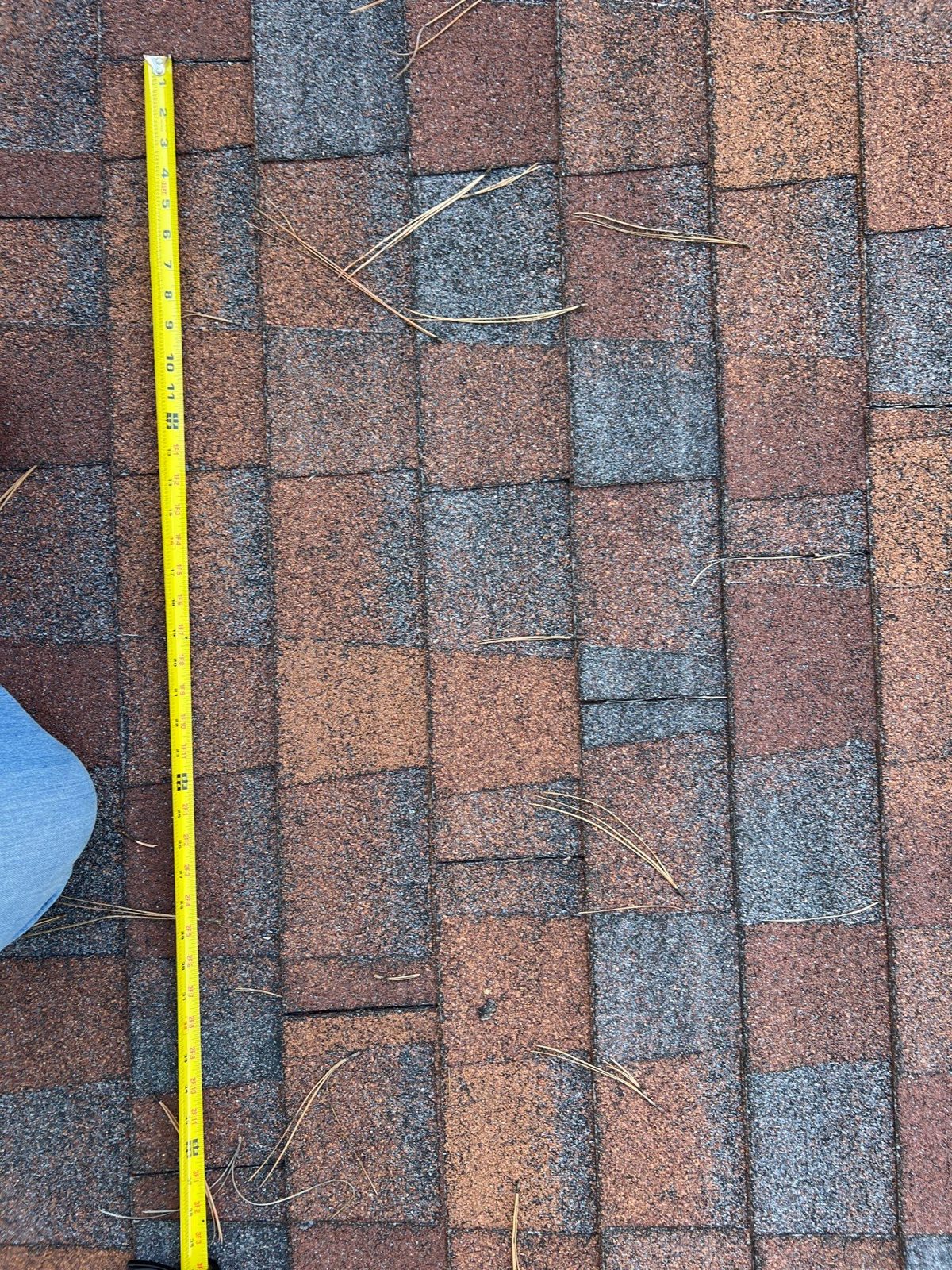
Minimum slopes vary by roofing material and are set in IRC/IBC tables. Asphalt shingles generally require a minimum 2:12 slope with standard underlayment and a 4:12 slope for single-layer application. Low-slope applications between 2:12 and 4:12 typically require double underlayment. Metal roofing and tile have their own slope minimums. The Cave Creek IRC reroof inspection checklist ties these slope requirements directly to inspection milestones, which gives you a useful reference for how AHJs apply them in practice.
Drainage, scuppers, and overflow
Flat and low-slope roofs with parapets must have secondary drainage. The IBC requires either overflow scuppers or secondary drains sized to handle the design rainfall rate. Missing or undersized secondary drainage is a common plan-review rejection point on commercial projects.
PV and rooftop equipment
Solar panel installations and rooftop mechanical equipment trigger additional code references. Many Arizona municipalities have added local amendments that address PV setbacks, fire-access pathways, and structural loading requirements for rooftop equipment. These amendments often go beyond the base I-Code, so check them specifically.
Pro Tip: Always cross-check the manufacturer’s installation instructions against the AHJ’s adopted code edition and local amendments. When they conflict, the stricter requirement governs. A manufacturer’s “minimum 2:12” instruction does not override an AHJ amendment requiring 3:12 for that material in that jurisdiction.
Reroofing rules: when you need a permit, overlay limits, and required inspections
Permit requirements for reroofs catch a lot of property owners off guard. The general rule: if you’re replacing roofing material down to the deck, adding a layer over existing material, or touching structural sheathing or framing, you need a permit.
Permit triggers
According to Scottsdale’s re-roofing handout, a permit is required when roofing sheathing or structural framing is repaired or replaced, and overlay rules by roof type apply. Most Arizona cities follow the same logic. Routine maintenance, such as replacing a few damaged shingles without touching the deck, typically does not require a permit, but the threshold varies by jurisdiction. When in doubt, call the AHJ’s building department directly.
Licensed contractors typically pull permits on behalf of property owners for commercial projects. Homeowners can often pull their own permits for residential work, but the contractor must still hold the appropriate ROC license to perform the work.
Overlay limits by material
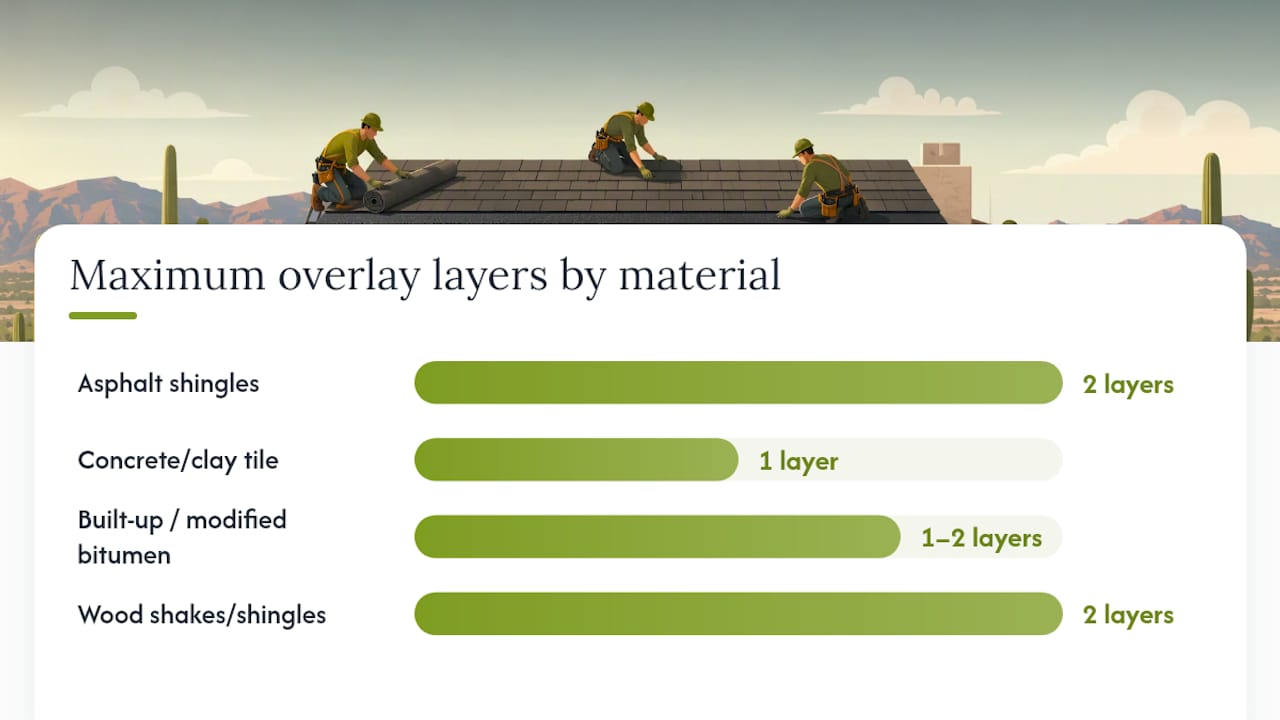
Most Arizona jurisdictions follow the IRC/IBC maximum of two total layers of roofing material. That means one overlay over an existing layer. Scottsdale’s handout confirms this for asphalt shingles: one overlay of asphalt shingles over an existing asphalt shingle roof is the maximum before tear-off is required.
| Material | Max Layers Allowed | Tear-Off Required When | Notes |
|---|---|---|---|
| Asphalt shingles | 2 total (1 overlay) | Existing layer count at max or deck damage | Most common AHJ rule; confirm locally |
| Concrete/clay tile | 1 layer | Almost always requires tear-off | Weight load may require structural review |
| Metal roofing | Varies by AHJ | When existing layers exceed limit or deck is damaged | Some AHJs allow metal over 1 shingle layer |
| Built-up / modified bitumen | 1–2 layers | When existing membrane is compromised | Low-slope systems; AHJ-specific rules apply |
| Wood shakes/shingles | 2 total (1 overlay) | Existing layer at max or fire-rating upgrade required | Class A upgrade often triggers full tear-off |
Heavy tile systems deserve special attention. Concrete and clay tile add significant dead load. When a tile reroof is proposed over an existing assembly, most AHJs require structural calculations or a span table letter from a licensed structural engineer confirming the framing can carry the added weight. Submitting that documentation with the permit application prevents plan-review delays.
Inspection milestones
Arizona AHJs generally require three inspection points on a reroof:
- Pre-inspection / deck inspection. Required before new material is applied when the deck is exposed or when an overlay is proposed. The inspector confirms deck condition, sheathing fastening, and that the existing layer count is within limits.
- Progress / nailing inspection. Called when underlayment is installed and fastening is visible but before final material covers it. This is where improper underlayment laps and missing nailing schedules get caught.
- Final inspection. Covers the completed assembly: flashing, ridge caps, penetration seals, ventilation, and drainage. The inspector checks that the installation matches the approved permit documents.
Pro Tip: Schedule your deck and nailing inspections before 10 AM during monsoon season (June through September). Afternoon storms can delay inspectors and push your project a full day. Calling the inspection line the evening before and confirming the morning slot is standard practice for experienced Arizona crews.
Who can legally do roofing in Arizona and how to verify a contractor
Roofing work in Arizona requires an active license from the Arizona Registrar of Contractors. The ROC issues licenses at the business level, not to individual workers. The license classification must match the scope of work, so a residential-only license does not cover a commercial reroof.
Common roofing-relevant ROC classifications include general residential contractor (B-1), general commercial contractor (B), and specialty roofing classifications such as C-42 (roofing) and CR-42 (residential roofing). The exact classification structure can be confirmed on the ROC’s own site, and the license number on any contract should match what the ROC lookup shows.
What to verify before signing a contract
- Active license status. The ROC public lookup shows whether the license is current or expired. An expired license voids the contractor’s legal authority to pull permits.
- Qualifying party. The ROC lists the individual responsible for the license. Confirm that person is still associated with the company.
- Bond and insurance. Arizona requires licensed contractors to carry a bond. Request a current certificate of insurance showing general liability and workers’ compensation coverage.
- License classification. Confirm the classification covers your project type (residential vs. commercial, specialty roofing vs. general).
- Complaint history. The ROC lookup shows any formal complaints or disciplinary actions. A single complaint is not automatically disqualifying, but a pattern is.
- Written warranty terms. Request the contractor’s warranty in writing before signing. Confirm it covers both workmanship and materials, and note the duration.
For a practical guide on what to ask a contractor before committing, Sladeroof’s how to pick a good roofer page walks through the credential and contract checklist in plain language.
How city and county amendments change roofing requirements
The base I-Codes give you a floor. Local amendments are where Arizona roofing requirements get specific, and where contractors who work across multiple jurisdictions get tripped up.
Why editions diverge across Arizona cities
Adoption timing is the first variable. A city that adopted the 2018 IBC and has not yet moved to the 2021 or 2024 edition operates under different technical requirements than a neighbor that updated last year. Local climate risks drive a second layer of divergence: wildfire exposure in the Prescott area, monsoon wind loads in the Phoenix metro, and high-altitude snow loads in Flagstaff all push AHJs toward amendments that tighten the base code for their specific conditions.
Common local amendments to watch for
- Mandatory Class A fire rating in designated WUI zones. Several Arizona cities have mapped WUI boundaries and require Class A for all new and replacement roofing within them, regardless of what the base IRC/IBC would allow.
- Higher wind uplift fastening schedules. Phoenix and other high-wind-zone cities often adopt ASCE 7 wind speed maps that require more fasteners per square foot than the base code’s default tables.
- Specific permit submittal checklists. Some AHJs require a manufacturer’s product data sheet, an installation diagram, and a completed reroof checklist as part of the permit application. Missing one item can delay intake by a week.
- Added inspection steps. A few jurisdictions require a pre-application site visit or a photo documentation submittal before issuing a reroof permit.
AHJ-check workflow
- Go to the city or county building department’s website and find the “adopted codes” or “building code” page. Phoenix publishes its adopted building code and local amendments on its development code page.
- Note the ordinance number and effective date for the current adopted edition.
- Read the local amendments to Chapter 9 (IRC) or Chapter 15 (IBC) specifically. These are the sections that modify roofing requirements.
- Request the AHJ’s reroof handout or inspection card. Most building departments have a one-page document that summarizes what they check at each inspection milestone.
The Arizona Building Officials (AZBO) site indexes municipal adoption pages across the state and is a useful starting point when you need to find a specific city’s current code adoption quickly.
Where to find the authoritative code text and how to read adoption pages
Knowing which code applies is only useful if you can read the actual text. Three sources cover most situations.
ICC Digital Codes is the primary platform for reading official I-Codes. The Arizona page lists jurisdictions that have published their adopted editions there. When a jurisdiction’s adopted code is on ICC Digital Codes, that version, including any published local amendments, is the authoritative text to cite on permit submittals.
UpCodes provides chapter-level navigation with local amendments surfaced inline. For readers who want to read IBC Chapter 15 or IRC Chapter 9 with Phoenix’s local modifications already integrated, UpCodes is faster to navigate than the raw ICC PDF. It is a research tool, not a substitute for the official adopted ordinance.
Municipal code portals are where you find the ordinance itself. The ordinance number, effective date, and list of adopted editions are the three pieces of information you need to confirm the controlling text.
| Source | Best Used For | How to Cite on Permit |
|---|---|---|
| ICC Digital Codes (codes.iccsafe.org) | Reading official I-Code text with published local amendments | Cite the edition year and jurisdiction name |
| UpCodes (up.codes) | Navigating chapter-level code with inline local amendments | Use for research; cite the official ordinance on the permit |
| City/county building code page | Finding the ordinance number and effective date | Cite the ordinance number and effective date directly |
| AZBO (azbo.us/az-codes.html) | Locating municipal adoption pages statewide | Use as an index to find the right city page |
Pro Tip: Copy the exact ordinance citation and effective date into your permit application cover sheet. Building department intake staff see dozens of applications weekly. A permit that clearly states “City of Phoenix Ordinance G-7123, effective January 1, 2024, adopting the 2024 IBC with local amendments” moves through intake faster than one that just says “2024 IBC.”
When institutional projects require higher roofing standards
Code minimums are a floor, not a ceiling. On state-funded and institutional projects in Arizona, owners routinely specify performance levels that exceed what any AHJ would require for a private build.
The Arizona State School Facilities Board (SFB) makes this concrete. SFB roofing specifications require manufacturer-certified installers with a minimum of five years’ experience and mandate a 20-year No Dollar Limit (NDL) warranty on certain state roofing projects. An NDL warranty means the manufacturer covers repair or replacement costs with no cap, which is a significantly higher standard than the typical limited material warranty a private homeowner receives.
Property owners on public or institutional projects should ask for the following before accepting a bid:
- Manufacturer certification for the installer. Not just a general contractor license, but documented certification from the roofing material manufacturer.
- NDL warranty documentation. Confirm the warranty is issued directly by the manufacturer, not just the contractor, and that it covers both materials and labor.
- Material testing and labeling. Confirm that the specified products carry the required fire and wind ratings and that the labels are on the materials delivered to the site.
- Documented maintenance plan. Institutional specs often require a written maintenance schedule as a condition of the warranty.
Exceeding minimum code is always permitted. When you submit an above-code assembly for plan review, note the higher specification in the submittal documents so the reviewer does not flag it as a deviation. AHJs generally welcome above-code assemblies but need to understand what they’re looking at.
What contractors actually see fail on Arizona inspections
The most common inspection failures in Arizona are not exotic. They are the same three problems, repeated across jurisdictions and material types.
Improper underlayment laps top the list. IRC and IBC specify minimum horizontal and vertical lap dimensions, and those dimensions change with slope. A crew that installs underlayment the same way regardless of pitch will fail the progress inspection on a low-slope section every time.
Missing or incomplete nailing schedules come second. The fastening schedule for a given wind zone is not optional, and inspectors check it at the progress milestone before the final layer goes on. If the schedule is not posted on-site or the pattern does not match the approved documents, the inspection fails.
Inadequate ventilation rounds out the top three. Net free ventilation area requirements are set in IRC Chapter 8 and referenced in Chapter 9. Contractors who focus on the roof covering and forget the ventilation calculation often reach the final inspection with a compliant surface but a failing assembly.
The single action that prevents most of these rejections: pull the AHJ’s specific fastening and underlayment requirements before ordering materials. Not the base IRC table, the AHJ’s adopted version with local amendments applied. A certified roof inspection before a reroof project can also surface existing deck or ventilation deficiencies that would otherwise show up as inspection failures mid-project.
For projects near monsoon season, scheduling storm-prep inspections before June gives you a clean baseline and avoids the permit-delay cascade that happens when a weather event interrupts an open permit.
Sladeroof handles the permit work so you don’t have to
Navigating Arizona’s jurisdiction-by-jurisdiction code requirements takes time most property owners and project managers do not have. Sladeroof brings over 20 years of combined roofing and insurance expertise to every project, which means permit packages go in complete the first time and inspections get scheduled around your timeline, not the other way around.
Two things Sladeroof does that reduce permit friction directly:
- Permit-package assembly. Sladeroof prepares the permit documents, including manufacturer data sheets, installation diagrams, and the AHJ-specific reroof checklist, so nothing is missing at intake.
- Inspection coordination. Sladeroof schedules and manages the deck, progress, and final inspections, and the crews know what each AHJ checks at each milestone.
ROC-qualified teams, a 25-year leak warranty, and a 50-year product warranty back every installation. For residential and commercial projects across Arizona, contact Sladeroof for a no-obligation permit-document review or installation consultation at Sladeroof.
Sources
- 07 30 00 - Roofing General Specification FINAL.pdf (Arizona SFB)
- Re-Roofing Handout (City of Scottsdale)
- 2121 IRC Inspection Checklist — Re-roof (Town of Cave Creek)
- Arizona - ICC Digital Codes
- Arizona Roofing License & Certification | 2024 Contractor Guide (ServiceTitan)
Recommended
Ready for a real answer on your roof?
Slade Roofing pairs licensed insurance agents with licensed roofers. Get your free inspection in about 30 seconds.
Get My Free Inspection →