
Modified Bitumen vs TPO: Which Roof Is Right for You?
Pick TPO when reflectivity, fast installation on large open roofs, and low weight are your top priorities. Pick modified bitumen when foot traffic, rooftop equipment, or multi-ply redundancy matter most. Both systems can have a long service life with proper maintenance, but the right choice depends on how your building actually gets used.
The strongest evidence behind each side:
TPO advantages:
- White TPO membranes deliver inherent cool-roof reflectivity that can satisfy codes like California’s Title 24 without add-on coatings, lowering cooling loads in hot climates
- Hot-air-welded seams create a continuous, factory-strength bond across the entire roof plane
- Single-ply installation moves faster on large, unobstructed decks, which keeps labor costs lower per square foot
Modified bitumen advantages:
- Multi-ply construction means a damaged top ply still has a backup layer underneath, reducing the risk of an immediate leak path through the system
- Thicker asphalt surfacing handles foot traffic and mechanical equipment far better than a single membrane
- Works well on cut-up, complex roofs where a single large sheet is impractical
One caveat applies to both: membrane thickness, attachment method, and maintenance frequency drive real-world outcomes more than the material name on the spec sheet.
Table of Contents
- TPO pros and cons: what the field actually shows
- What is modified bitumen roofing, and how is it installed?
- Modified bitumen pros and cons: the honest trade-offs
- How do the costs actually compare?
- Durability, lifespan, and climate fit: a direct comparison
- Installation methods, safety risks, and what they mean for your schedule
- Maintenance needs and common problems to watch for
- How to choose between TPO and modified bitumen
- Warranties and insurance: what actually matters
- Quick recommendations by building type
- How Sladeroof evaluates and installs both systems
- Key Takeaways
- The trade-off most building owners get wrong
- Sladeroof can help you choose and install the right system
- Useful sources and further reading
TPO pros and cons: what the field actually shows
Pros:
- Reflectivity is built in. White TPO typically reflects a large portion of solar radiation, reducing cooling loads in warm climates. Modified bitumen can meet cool-roof requirements only with a reflective cap sheet or an applied coating, which adds cost and a maintenance obligation.
- Lower membrane weight puts less stress on aging structural decks.
- Large-format rolls install quickly on open roofs, which matters when minimizing business disruption is a priority.
- Manufacturer warranty terms vary by membrane thickness and brand, often offering longer coverage for thicker membranes.
Cons:
- Single-ply means a single failure point. A deep puncture from a dropped tool or a sharp piece of equipment creates a direct leak path with no backup layer.
- Seam quality is everything. An undertrained crew or a cold-weather install rushed without proper surface prep can produce seams that look fine and fail within two years.
- Early TPO formulations from the 1990s and early 2000s had documented durability problems. Modern membranes are significantly better, but specifying a recognized manufacturer and a current-generation product still matters.
TPO typically outperforms modified bitumen on large warehouse roofs, distribution centers, and any building where a cool-roof code applies or where energy savings on air conditioning are a measurable priority.
What is modified bitumen roofing, and how is it installed?
Modified bitumen is an asphalt-based roofing system that evolved from traditional built-up roofing (BUR). Where old-school tar-and-gravel systems required multiple hot-mopped plies applied on the roof, modified bitumen uses factory-manufactured sheets that incorporate polymer modifiers directly into the asphalt, improving flexibility and durability before the roll ever reaches the jobsite.
The two main chemistries are SBS and APP:
A standard modified bitumen assembly uses at least two plies: a base sheet bonded to the substrate and a cap sheet on top. The cap sheet carries the granule surface or smooth finish that handles UV exposure and foot traffic. That layered construction is the system’s core advantage over single-ply membranes.
Installation methods vary significantly:
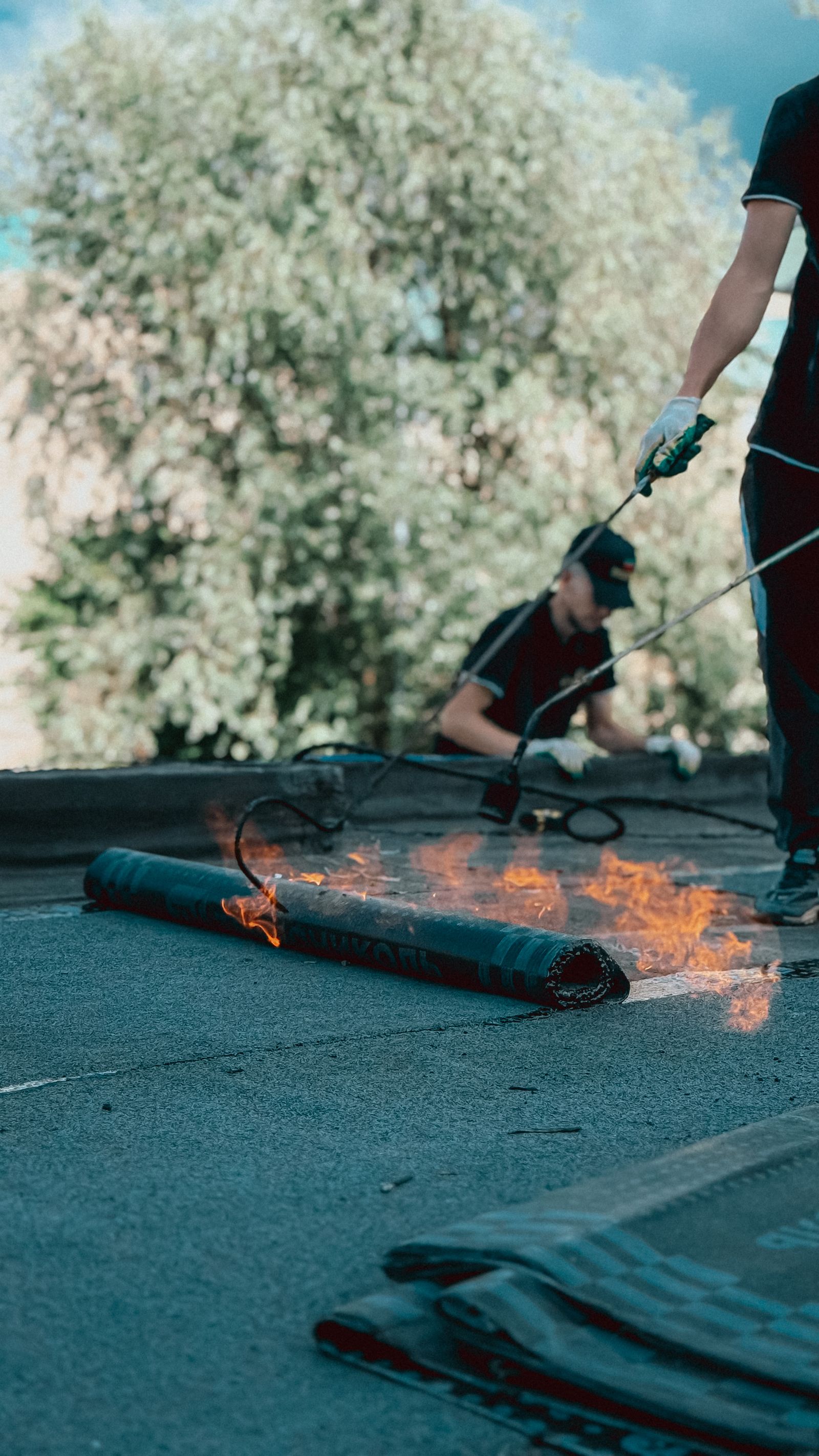
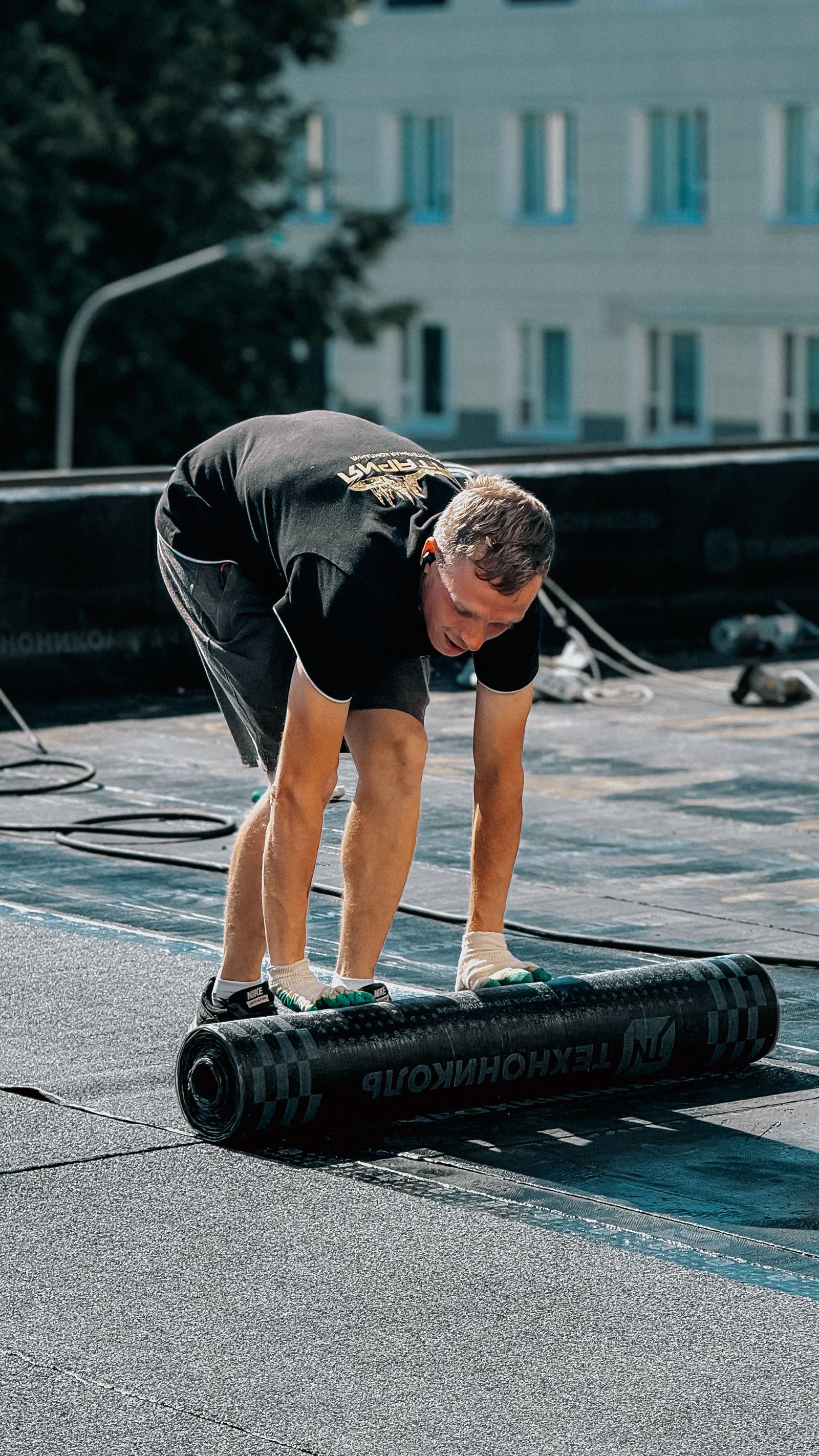
- Torch-down: — A propane torch melts the underside of the cap sheet as it unrolls, bonding it to the base sheet below. Fast and creates a strong bond, but introduces open-flame risk.
Modified bitumen pros and cons: the honest trade-offs
Pros:
- Multi-ply redundancy is the headline advantage. If the cap sheet takes a hit, the base sheet still holds. Single-ply systems have no equivalent backup.
- Granule-surfaced cap sheets handle foot traffic, dropped tools, and HVAC service visits far better than a bare TPO membrane.
- Works well on roofs with complex geometry, multiple penetrations, and tight corners where large TPO sheets are difficult to detail cleanly.
- Repair is straightforward: a patch of matching cap sheet, torched or cold-applied, blends into the existing surface.
Cons:
- Standard dark-surfaced modified bitumen absorbs heat, raising cooling loads. A reflective granule cap sheet or a field-applied coating addresses this but adds cost.
- Heavier than TPO, which matters on older buildings with marginal structural capacity.
- Torch-down installation requires fire-safety protocols, a fire watch after work, and may be restricted or prohibited on occupied buildings or wood-frame structures.
- Installation takes longer per square foot than TPO on large open roofs, which translates to higher labor costs on big projects.
Modified bitumen is the professional choice for rooftop mechanical yards, hospitals, schools with frequent HVAC service, and any building where a single membrane puncture would be catastrophic.
How do the costs actually compare?
Installed cost ranges for both systems overlap considerably. Reported market ranges put modified bitumen at roughly $4–$8 per square foot and TPO at roughly $5–$10 per square foot, depending on membrane thickness, attachment method, insulation, and local labor rates. On a large, simple roof, TPO’s faster installation can push its total cost below modified bitumen. On a complex, cut-up roof, that labor advantage disappears.
Cost context: Both systems commonly fall in a $4–$9 per sq ft range for standard commercial installations. The gap between a thin, mechanically fastened TPO and a fully adhered, 80-mil TPO with a cover board can be larger than the gap between TPO and modified bitumen at comparable specs.
Lifecycle cost is where the comparison gets more nuanced:
- TPO’s reflectivity can meaningfully reduce cooling costs in hot, sunny climates over a 20-year period. In Idaho or Wyoming, where heating loads dominate, that advantage shrinks.
- Modified bitumen on a high-traffic roof may require fewer repairs over its life than a TPO roof without walkpads and cover boards, which narrows or eliminates TPO’s initial cost edge.
- Tear-off versus recover also changes the math. If the existing roof can legally accept a recover, both systems can be installed over it, saving $1–$2 per square foot in disposal costs.
When comparing bids, look beyond the headline price per square foot. Ask each contractor to specify membrane thickness, insulation R-value, attachment method, warranty type and duration, and the expected maintenance schedule. Two bids at the same price per square foot can represent very different 20-year costs.
Durability, lifespan, and climate fit: a direct comparison
| Factor | TPO | Modified Bitumen |
|---|---|---|
| Typical lifespan | 20–25 years | 20–25 years |
| Membrane thickness | 45–80 mil (single ply) | Multi-ply (base + cap) |
| Puncture resistance | Moderate; cover boards needed for heavy traffic | High; granule cap sheet handles foot traffic |
| Seam failure risk | High if welds are poor quality | Lower; laps are wide and bonded across full width |
| Ponding water tolerance | Good with proper slope; standing water degrades seams over time | Good; multi-ply resists prolonged saturation better |
| UV weathering | White surface resists UV well; dark TPO degrades faster | Granule surface protects asphalt; smooth cap needs coating |
| Cold-climate performance | Performs well; some membranes can crack at extreme low temps | SBS chemistry excels in freeze-thaw cycles |
| Hot-climate performance | White TPO reduces cooling load significantly | Requires reflective cap or coating to match TPO’s performance |
| Best use case | Large open roofs, energy-focused buildings, cool-roof code compliance | High-traffic roofs, rooftop equipment, complex geometry |
Both systems reach the upper end of their lifespan range only with proper installation and regular maintenance. A 60-mil TPO installed by a certified crew and inspected annually will outlast a 45-mil TPO installed by the lowest bidder with no follow-up. The same principle applies to modified bitumen: a two-ply system with a quality granule cap sheet and annual drain clearing will perform very differently from a single-ply mod-bit recover done on the cheap.
Installation methods, safety risks, and what they mean for your schedule
Understanding how each system goes down helps you ask the right questions before signing a contract.
Modified bitumen installation options:
- Torch-down: — The most common method for APP cap sheets. A propane torch melts the membrane underside as it unrolls. Produces a strong bond but requires open-flame management, a designated fire watch after work ends, and may violate fire codes on wood-frame or occupied buildings.
TPO installation options:
Pro Tip: If your building is occupied, wood-frame, or located in a high-wildfire-risk area (common in Idaho, Arizona, and Wyoming), specify cold-applied or self-adhered modified bitumen, or switch to TPO entirely. Torch-down on an occupied building is a liability exposure that no schedule advantage justifies.
Fire watch after torch-down work is not optional. Most jurisdictions and insurance carriers require a trained observer to remain on-site for 30–60 minutes after all torch work ends, checking for smoldering material in the substrate or walls. Contractors who skip this step are cutting corners on your liability, not just theirs.
Crew skill differences matter too. A hot-air weld on TPO requires a trained operator who monitors weld temperature, speed, and overlap width. An undertrained crew can produce seams that pass a visual inspection and fail under the first winter freeze-thaw cycle. Ask for welder certifications and request that probe testing of seams be included in the scope.
Maintenance needs and common problems to watch for
Both systems reward consistent attention. Here is what a practical maintenance program looks like for each.
For TPO roofs:
- Inspect seams twice a year (spring and fall) for lifting edges, bubbling, or discoloration that signals incomplete fusion.
- Check all flashings and termination bars at penetrations, walls, and drains; these are the most common entry points for water.
- Clear roof drains and scuppers every spring and after major storms. Ponding water accelerates seam degradation and puts structural load on the deck.
- Install rubber walkpads on any path that service personnel use regularly. TPO without walkpads shows wear quickly under repeated foot traffic.
- Re-weld any lifted seam edges promptly. A two-inch lifted seam costs almost nothing to fix; the same seam after a winter of freeze-thaw cycling can mean a full section replacement.
For modified bitumen roofs:
- Inspect the cap sheet surface for blisters, which form when moisture trapped between plies expands under heat. Small blisters can be cut, dried, and patched; large blistering patterns indicate a systemic adhesion failure.
- Check granule coverage on the cap sheet. Bare spots expose the asphalt to UV degradation and accelerate aging.
- Examine all laps and end laps for separation or lifting. Cold-applied and self-adhered systems are more prone to lap separation in extreme temperature swings.
- Clear drains and check for ponding areas. Modified bitumen tolerates standing water better than TPO, but prolonged saturation still degrades the asphalt over time.
- Apply a reflective coating to dark-surfaced cap sheets if energy costs are a concern, and plan to recoat every 5–7 years as the coating weathers.
Routine commercial roof maintenance preserves both manufacturer and installer warranties. Most manufacturer NDL warranties require documented annual inspections; skipping them gives the manufacturer grounds to deny a claim.
How to choose between TPO and modified bitumen
Work through this checklist before you talk to a contractor.
Decision checklist:
- Climate: Hot and sunny with cooling-dominated energy costs? TPO’s reflectivity pays back. Cold climate with hard freezes and minimal air conditioning? The energy advantage shrinks; modified bitumen with SBS chemistry handles freeze-thaw well.
- Roof size and geometry: Large, open, unobstructed deck? TPO installs faster and costs less per square foot. Cut-up roof with many penetrations, curbs, and tight corners? Modified bitumen details more cleanly.
- Foot traffic and equipment: HVAC units, rooftop tenant equipment, or regular service visits? Modified bitumen’s granule cap sheet handles this without add-ons. TPO needs cover boards and walkpads, which add cost and complexity.
- Energy goals: Cool-roof code compliance required (common in Arizona and California)? White TPO meets most mandates without extra steps. Modified bitumen needs a reflective cap or coating.
- Building occupancy and fire risk: Occupied building, wood-frame construction, or wildfire-prone area? Eliminate torch-down from the options. Self-adhered modified bitumen or TPO are both viable.
- Structural capacity: Older building with marginal deck load ratings? TPO’s lighter weight may be the deciding factor.
Questions to ask every contractor bidding the job:
- What membrane thickness are you specifying, and why?
- What attachment method are you using, and how does it affect the wind-uplift rating?
- Are you a factory-certified installer for the manufacturer’s NDL warranty program?
- How do you test welds? (Probe testing is the standard; visual-only is a red flag.)
- Can you provide references for at least two similar projects completed in the last three years?
Red flags to walk away from:
- A contractor who cannot name the membrane manufacturer or thickness on the bid
- No NDL warranty offered, only a short installer workmanship warranty
- Pricing significantly below other bids with no explanation of what was removed from scope
- Vague seam descriptions (“we heat-weld everything”) with no mention of testing protocols
- Unwillingness to provide references for comparable projects
Warranties and insurance: what actually matters
The difference between a manufacturer NDL warranty and an installer workmanship warranty is not a technicality. It determines who pays when something goes wrong.
Manufacturer NDL (No-Dollar-Limit) warranty: Covers the cost of labor and materials to repair or replace a defective membrane, up to the full replacement value, for the warranty term. Typical durations run 10–30 years depending on membrane thickness and the manufacturer’s program. To qualify, the installer must be factory-certified, the membrane must meet the specified thickness, and the owner must maintain the roof per the manufacturer’s requirements (usually annual inspections and documented maintenance).
Installer workmanship warranty: Covers defects in the contractor’s installation work, typically for 2–10 years. This warranty is only as good as the contractor’s financial stability. A contractor who goes out of business takes their workmanship warranty with them.
For commercial properties, the combination of a manufacturer NDL warranty and a contractor workmanship warranty provides the most complete coverage. Sladeroof’s warranty structure includes a 25-year leak warranty and a 50-year product warranty, which goes well beyond what most contractors offer.
Insurance implications:
- Some commercial property insurers offer premium reductions for roofs with documented manufacturer warranties, impact-resistant ratings, or fire-rated assemblies.
- Torch-down modified bitumen may trigger higher premiums or exclusions on wood-frame buildings; self-adhered or cold-applied methods avoid this.
- A documented maintenance record is often required to support an insurance claim after a weather event. Gaps in maintenance history give insurers grounds to reduce or deny claims.
Warranty checklist for your contract:
- Membrane thickness is explicitly stated and matches the manufacturer’s warranty requirement
- Installer is named as a factory-certified applicator for the specified manufacturer
- Maintenance obligations are listed (inspection frequency, drain clearing, prohibited activities)
- Warranty is transferable to a future owner (critical for resale value)
- Exclusions are clearly stated (most warranties exclude ponding water damage, so slope and drainage matter)
Insurance claim assistance is most straightforward when the roof was installed to manufacturer specs and the maintenance record is clean. That documentation starts at installation.
Quick recommendations by building type
- Rooftop mechanical yard or building with heavy HVAC equipment: Modified bitumen with a granule cap sheet. Cover boards and walkpads add cost to a TPO system and still do not match the inherent traffic tolerance of a two-ply asphalt assembly.
How Sladeroof evaluates and installs both systems
Every Sladeroof commercial project starts with a roof survey before any system is recommended. That survey covers substrate condition, existing insulation R-value, drain locations and flow capacity, traffic patterns, and any known problem areas from the building’s maintenance history. The system recommendation comes out of that assessment, not from a preference for one product over another.
Sladeroof’s installation process follows these practices regardless of which system is specified:
- Warranty documentation from day one: Sladeroof’s commercial roofing services include the paperwork trail that manufacturer NDL warranties require, including installation records, membrane thickness verification, and the maintenance schedule handed to the owner at project close.
Pro Tip: Ask your contractor to hand you the manufacturer’s warranty registration confirmation before they leave the job. Many owners discover years later that the warranty was never registered, which voids the NDL coverage entirely.
Sladeroof also handles insurance claim facilitation as part of the project process. When a roof replacement is triggered by a weather event, the documentation from a properly installed and maintained roof makes the claim process significantly cleaner.
Key Takeaways
The right choice between modified bitumen and TPO comes down to three things: how your building gets used, what your climate demands, and whether the contractor can back the installation with a manufacturer NDL warranty.
| Point | Details |
|---|---|
| TPO wins on energy and speed | White TPO meets cool-roof codes and installs faster on large open roofs, lowering labor cost per square foot. |
| Modified bitumen wins on traffic and redundancy | Multi-ply construction handles foot traffic and equipment without add-ons, and a damaged cap sheet still has a backup layer. |
| Installed costs overlap | Both systems typically fall in a $4–$10 per sq ft range; attachment method and membrane thickness matter more than material name. |
| Warranty type determines real protection | A manufacturer NDL warranty covers full replacement cost; an installer-only warranty disappears if the contractor does. |
| Sladeroof installs both systems | Sladeroof surveys the roof, specifies the right system, and delivers the documentation needed for manufacturer warranties and insurance claims. |
The trade-off most building owners get wrong
Most owners frame this decision as TPO versus modified bitumen, when the real question is single-point failure versus redundancy. A single-ply membrane on a roof that sees daily service traffic is not a cost savings. It is a deferred repair bill.
The buildings where I see TPO underperform are almost always ones where the owner chose it for the lower initial price on a roof that also hosts rooftop equipment or sees regular HVAC service visits. The cover boards and walkpads that should have been specified were value-engineered out, and within five years the membrane has punctures, lifted seams near equipment curbs, and a warranty dispute in progress.
Modified bitumen gets unfairly dismissed as old technology. The torch-down fire risk is real and worth taking seriously, but self-adhered and cold-applied systems eliminate it entirely. A two-ply SBS system on a complex roof in a cold climate is still one of the most durable assemblies available, and it does not require a certified welder to repair a damaged section.
The honest answer is that both systems, installed correctly and maintained consistently, perform well. The gap between a good installation and a poor one is larger than the gap between the two materials.
Sladeroof can help you choose and install the right system
Choosing between TPO and modified bitumen is easier when someone who installs both systems walks the roof with you first. Sladeroof provides commercial roofing inspections, new installations, and insurance claim assistance across Idaho, Arizona, and Wyoming, with a process built around getting the specification right before the first roll of membrane is ordered.
A side-by-side TPO versus modified bitumen bid from Sladeroof includes membrane thickness options, attachment method comparisons, warranty terms for each system, and a clear explanation of how each choice affects your maintenance obligations and insurance position. To get an accurate estimate faster, have your roof’s square footage, building use, known traffic patterns, and any existing leak history ready when you reach out. Contact Sladeroof to schedule a commercial roof inspection and get a specification-level bid for your building.
Useful sources and further reading
The following sources were used in preparing this article. They are worth bookmarking if you are working through a specification or evaluating contractor bids.
- Single-Ply vs Modified Bitumen | Flat Roof Report
- Modified Bitumen vs TPO Roof: Cost & Which to Pick
- TPO Roofing Versus Torch Down: A Comprehensive Comparison — Rescreening Masters
- TPO vs. Modified Bitumen: Choosing a Flat Roof System for Southern California Buildings | LA Roofing Materials
- Modified Bitumen Vs TPO Roofing Cost And Performance Guide
- Commercial Roofing Idaho | Prevent Expensive Leaks Now
For jurisdiction-specific requirements, check your local building department and applicable energy codes. Cool-roof mandates vary by state and climate zone; what applies in Arizona may not apply in Idaho or Wyoming.
Recommended
Ready for a real answer on your roof?
Slade Roofing pairs licensed insurance agents with licensed roofers. Get your free inspection in about 30 seconds.
Get My Free Inspection →