
Roof Insurance Deductible: What Homeowners Should Know
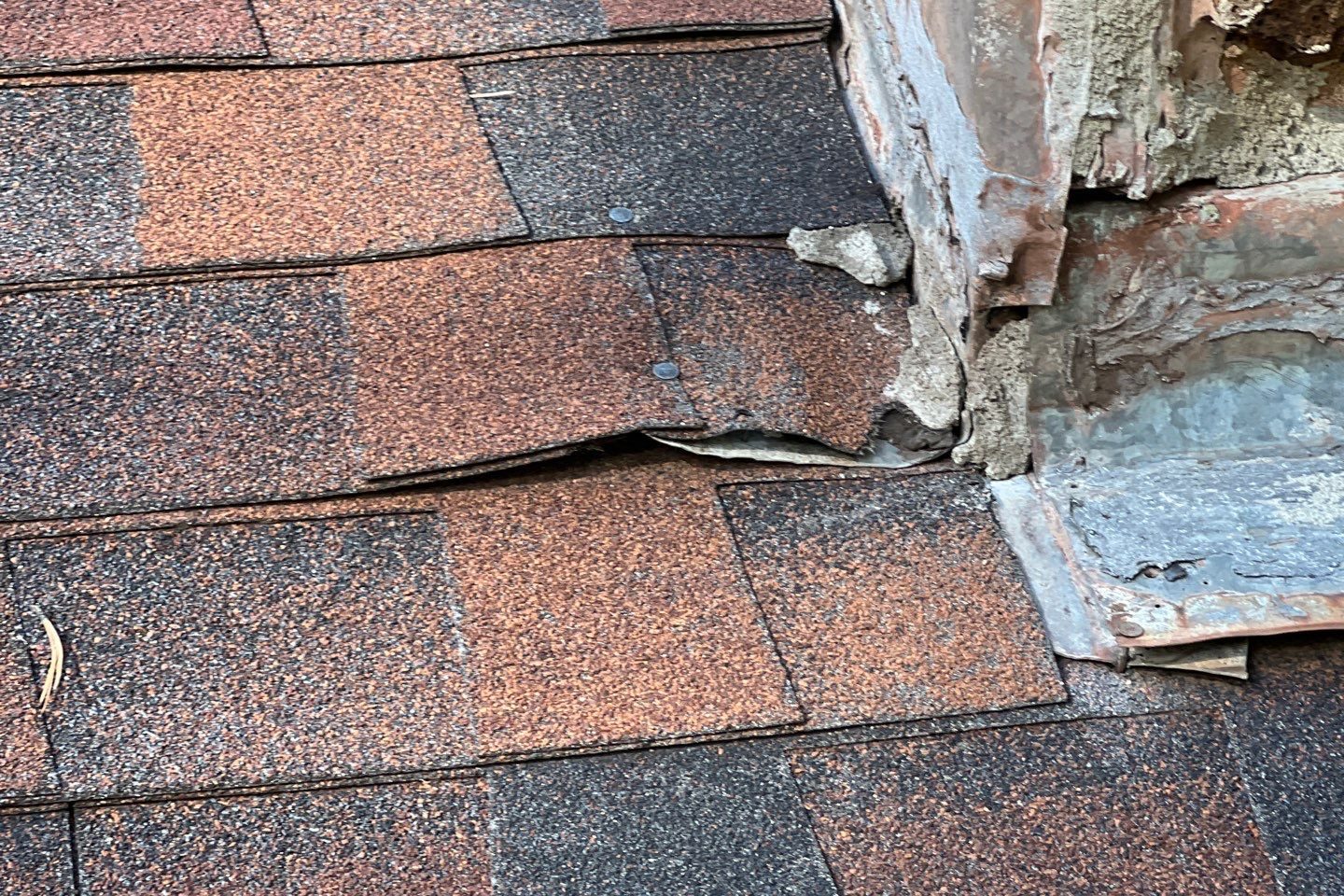
A roof insurance deductible is the dollar amount you pay out of pocket before your homeowners policy covers the rest of a roof repair or replacement. It can be a flat dollar figure or a percentage of your home’s insured value, and knowing which one applies to you changes how much cash you need on hand after a storm.
Do these three things right now:
- Pull your declarations page. It lists your exact deductible type and amount, not the generic figure a neighbor quoted you.
- Check for a wind, hail, or named-storm deductible. Many policies carry a separate, higher deductible for storm perils than for other claims.
- Set aside cash to cover it. A percentage deductible on a high-value home can run into five figures, and you’ll need to pay it before repairs start.
Key Takeaways
A roof insurance deductible determines your minimum out-of-pocket cost on every covered claim, and understanding whether yours is flat or percentage-based is the single most useful thing you can check today.
| Point | Details |
|---|---|
| Two deductible types exist | Flat-dollar amounts stay fixed; percentage deductibles scale with your dwelling coverage limit. |
| Storm deductibles run higher | Wind, hail, and named-storm deductibles often run 1% to 5% of your dwelling limit, separate from your standard deductible. |
| Contractors can’t waive deductibles | Any offer to “eat” your deductible usually involves invoice fraud; verify estimates independently instead. |
| Match your deductible to your savings | Raise it only if you can genuinely cover the higher amount in cash after a covered loss. |
| Sladeroof supports the full process | Sladeroof pairs impact-resistant installations with claims documentation and adjuster coordination across Idaho, Arizona, and Wyoming. |
Table of Contents
- What Is a Roof Insurance Deductible: Flat-Dollar vs. Percentage
- How Do Wind and Hurricane Deductibles Differ From Standard Ones?
- What Are Typical Roof Deductible Amounts Today?
- How Deductibles Affect Roof Repair and Replacement Payouts
- Can a Roofer Waive My Insurance Deductible?
- How Do You Choose the Right Roof Deductible?
- Does Roof Deductible Guidance Vary By State?
- How a Roofing Contractor Helps You Navigate a Claim
- A Roofer’s Take on Deductibles and Prevention
- Get Help With Your Next Roof Inspection or Claim
- Frequently Asked Questions
- Sources
What Is a Roof Insurance Deductible: Flat-Dollar vs. Percentage
Your deductible applies to covered property claims, like wind, hail, or fire damage. It doesn’t apply to liability claims, and it won’t apply at all if your roof failure was caused by age or neglect rather than a sudden event.
A flat-dollar deductible is the simpler of the two. If your policy has a $1,000 deductible and a covered repair costs $10,000, your insurer pays $9,000 and you cover the rest, according to GEICO.
A percentage-based deductible is calculated against your Coverage A dwelling limit, not your repair bill. A 2% deductible on a $400,000 dwelling limit means an $8,000 obligation, whether the repair costs $9,000 or $30,000.
- Flat-dollar: predictable, easier to budget for, but often paired with higher premiums.
- Percentage-based: usually lowers your premium, but the dollar amount grows automatically as your dwelling value rises.
How Do Wind and Hurricane Deductibles Differ From Standard Ones?
Insurers in storm-prone states frequently carve out a separate deductible for wind, hail, hurricane, or named-storm damage, and it’s almost always percentage-based rather than flat, per the Insurance Information Institute.
- A 2% wind/hail deductible on a $400,000 home equals $8,000, which is separate from your standard deductible.
- Some policies apply this deductible per occurrence; others apply it once per hurricane season or policy year.
Roughly 1% to 5% of your dwelling limit is the typical range carriers use for these storm-specific deductibles, with many landing between 1% and 3%.
Pro Tip: Call your agent and ask them to define “named storm” and “hurricane” exactly as your policy uses those terms. Some carriers only trigger the higher deductible once a storm gets an official name from the National Hurricane Center.
What Are Typical Roof Deductible Amounts Today?
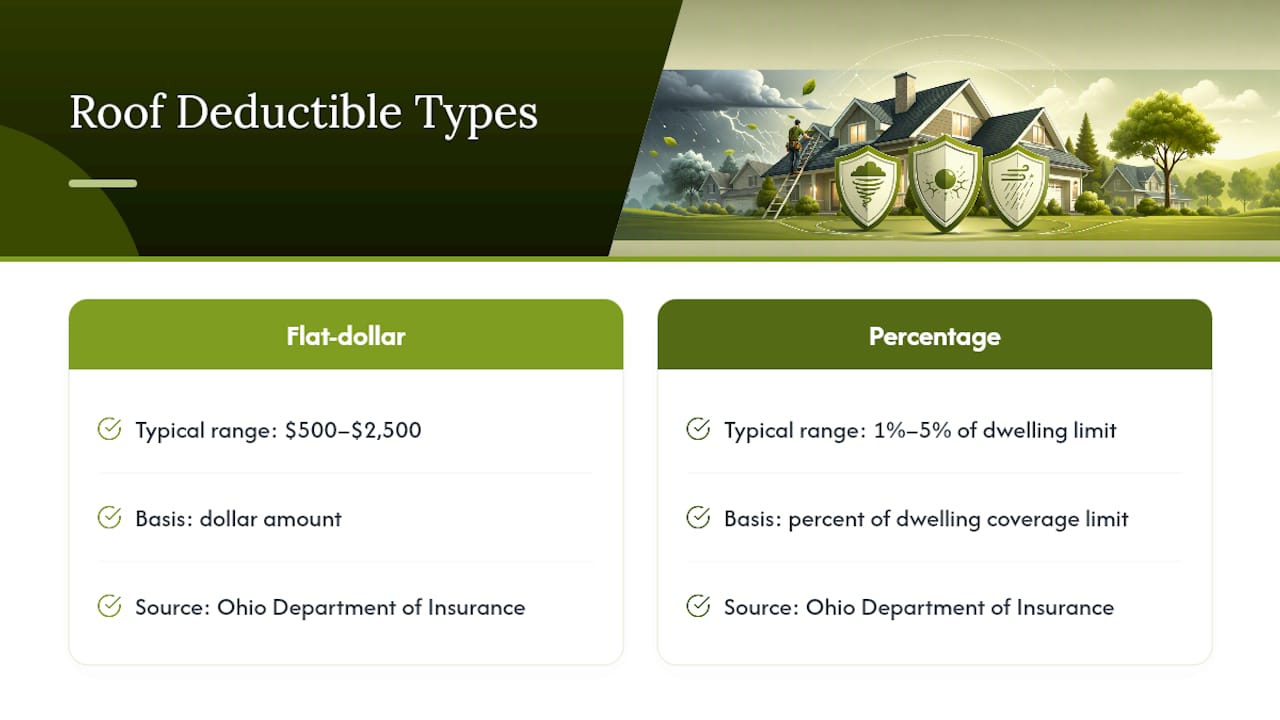
Flat-dollar deductibles usually run $500 to $2,500. Percentage deductibles typically fall between 1% and 5% of the dwelling limit, with storm-specific deductibles clustering closer to 1% to 3%.
- A mid-value home insured at $250,000 with a 1% deductible pays $2,500 out of pocket, similar to a flat $1,000 to $2,500 policy.
- A higher-value home insured at $400,000 to $500,000 with a 2% deductible faces $8,000 to $10,000 out of pocket, according to the Ohio Department of Insurance.
That jump isn’t random. As home values and rebuild costs climb, percentage deductibles scale up automatically since they’re tied to your dwelling coverage limit, not a fixed dollar figure set years ago.
How Deductibles Affect Roof Repair and Replacement Payouts
Say your roof needs full replacement at $18,000. Your policy carries a $2,500 wind/hail deductible and pays Replacement Cost Value (RCV). The insurer first issues an Actual Cash Value (ACV) payment, subtracting both depreciation and your deductible. Once repairs are complete and you submit invoices, the carrier releases the recoverable depreciation, closing the gap toward the full $18,000, minus your $2,500, according to Insurance Curator’s claim modeling.
- Repair cost below your deductible: pay out of pocket; filing isn’t worth the claim history.
- Repair cost slightly above your deductible: weigh the net payout against a possible premium increase.
- Full replacement well above your deductible: filing usually makes sense, especially with a documented storm event.
Pro Tip: Get a written contractor estimate before you call your insurer. A thorough inspection often finds hidden decking or flashing damage that changes the whole claim math.
Filing a claim doesn’t just affect this payout. Insurers use claims history in underwriting, and multiple roof claims in a short window can push your premium up at renewal even if each individual claim was small, as our guide to how roofing claims work explains in more detail.
Can a Roofer Waive My Insurance Deductible?
No. A contractor cannot lawfully change or absorb the deductible your insurer set. When someone offers to “eat” your deductible, they’re usually planning to inflate the invoice or misrepresent the scope of work to your carrier, a practice Progressive flags as a red flag for homeowners to watch for.
- Requests to sign a blank or inflated invoice.
- Promises of a rebate or “cash back” after the claim closes.
- Pressure to sign a contract before an adjuster has even inspected the roof.
Instead: document the damage yourself, get an independent estimate, and hire a roofer who invoices accurately and works transparently with your adjuster.
How Do You Choose the Right Roof Deductible?
The right deductible balances your monthly premium against your ability to cover a surprise bill.
- Check your emergency savings against your highest possible deductible exposure, not just your average one.
- Weigh your local storm risk. Hail-belt and hurricane-coast homeowners face higher odds of hitting that deductible.
- Factor in your roof’s age. An older roof raises the odds of a claim, which makes a lower deductible more attractive despite the premium cost.
Ask your agent three things: what type of deductible applies to wind/hail damage, whether it’s per-occurrence or per-season, and how raising or lowering it would change your premium. Raising your deductible saves money monthly but only makes sense if you could genuinely cover the higher amount in cash tomorrow.
Does Roof Deductible Guidance Vary By State?
Yes. Wind and hail deductible rules, allowable endorsements, and minimum coverage requirements vary significantly by state, so a rule you read about online may not apply where you live.
- The Texas Department of Insurance publishes specific guidance for homeowners replacing storm-damaged roofs, including how deductibles interact with named-storm claims.
- Search “[your state] department of insurance roof deductible” to find your regulator’s current guidance rather than relying on general roofing blogs.
- Always confirm the exact endorsement name and amount on your own declarations page. Generic web articles can’t see your actual policy.
How a Roofing Contractor Helps You Navigate a Claim
A roofer who understands insurance does more than swing a hammer. During a claim, that contractor typically provides:
- A detailed, itemized estimate that matches what the adjuster needs to see.
- Photo documentation of storm damage, including areas easy to miss from the ground.
- Emergency tarping to prevent further damage while the claim processes.
- Accurate, itemized invoices that support your recoverable depreciation payout.
Homes built with impact-resistant materials tend to see fewer repeat claims after hailstorms compared to standard shingle installations, since the roofing system is engineered to absorb impact rather than crack on the first hit.
Pro Tip: Before signing with any roofer, ask for their license, a written warranty, and a sample invoice format. If they can’t show you all three, keep looking.

A Roofer’s Take on Deductibles and Prevention
I’ve seen homeowners skip their annual pre-storm inspection to save a few hundred dollars, then end up scrambling to cover a $6,000 deductible six months later. My recommendation is simple: get your roof inspected before storm season every year, and keep a dedicated fund equal to your deductible. It’s cheaper than the alternative.
Get Help With Your Next Roof Inspection or Claim
Sladeroof has spent more than 20 years working both sides of this problem, roofing and insurance, which is why our installations are engineered to hold up against wind and hail before a claim ever becomes necessary. We back our work with a 25-year leak warranty and a 50-year product warranty, and our team handles the paperwork side too: documentation, adjuster coordination, and accurate invoicing so your recoverable depreciation actually gets paid.

If your roof took a hit this season, or it’s simply due for a pre-storm checkup, request a roof inspection or reach out for insurance claim assistance in Idaho, Arizona, or Wyoming. Getting ahead of the damage now is a lot cheaper than covering a five-figure deductible later.
Frequently Asked Questions
What is a typical roof insurance deductible? Flat-dollar deductibles usually run $500 to $2,500, while percentage-based deductibles typically fall between 1% and 5% of your dwelling coverage limit, according to the Ohio Department of Insurance.
Is a roof replacement tax-deductible? No. The IRS treats most roof work as a capital improvement or maintenance expense, not an immediately deductible cost.
Can I negotiate my roof insurance deductible with my contractor? No. Your deductible is set by your insurance policy, not your contractor. Any roofer offering to waive or absorb it is likely proposing an invoicing scheme that could put your claim, and you, at legal risk.
Should I file a claim if my repair cost is close to my deductible? Usually not. If the covered repair barely exceeds your deductible, filing may not be worth the eventual premium impact. Get a written estimate first and compare it against your exact deductible amount before deciding.
How do I find my state’s specific roof deductible rules? Search “[your state] department of insurance roof deductible” or check your state DOI’s consumer guidance page directly, similar to the Texas Department of Insurance’s guidance, rather than relying on general roofing articles.
This article is general information, not a substitute for advice from a qualified financial advisor. Consult a qualified financial professional about your own circumstances before acting on anything here.
Sources
- Publication 17 (Your Federal Income Tax) — IRS
- Background on hurricane and windstorm deductibles — Insurance Information Institute
- Roof insurance — repair and replacement guidance — Ohio Department of Insurance
- Replacing your roof — Tips from Texas Department of Insurance (TDI)
- What Is a Homeowners Insurance Deductible? — GEICO
Recommended
Ready for a real answer on your roof?
Slade Roofing pairs licensed insurance agents with licensed roofers. Get your free inspection in about 30 seconds.
Get My Free Inspection →