
Your Complete Roof Replacement Timeline: What to Expect
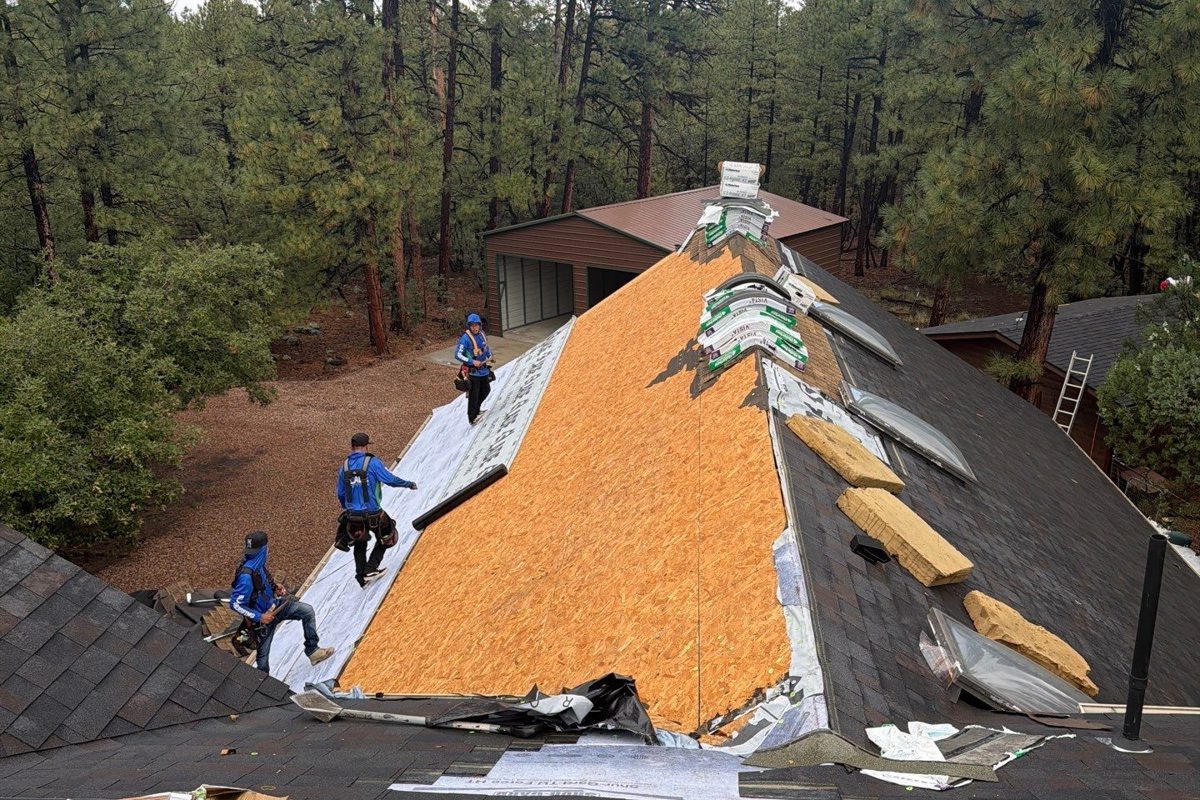
A typical asphalt shingle roof installs in 1–3 working days, but the full project from first phone call to final walkthrough usually spans 2–8 weeks. That gap surprises almost every homeowner. The active installation is a small slice of the calendar. Permits, material ordering, contractor scheduling, and HOA approvals fill the rest.
For the most common scenario, a 2,000–2,500 sq ft home with asphalt shingles, here is what the numbers look like:
- Active installation: 1–3 days on-site
- Full project calendar: 2–8 weeks start to finish
- Cost range for that home size: roughly $9,000–$12,000
The range is wide because no two projects share the same permit office, material supplier, or weather window. A straightforward job in a fast-permit municipality with shingles in stock can close in two weeks. A job requiring custom tile, HOA sign-off, and a backlogged crew can stretch to eight.
Key Takeaways
A roof replacement spans 2–8 weeks total, but active installation is only 1–5 days — permits, materials, and scheduling fill the rest of the calendar.
| Point | Details |
|---|---|
| Installation vs. calendar time | Active install runs 1–5 days; the full project from estimate to walkthrough takes 2–8 weeks. |
| Material affects both install days and lead time | Asphalt installs in 2–4 days with 1–5 day lead times; slate takes 7–14 install days and up to 16 weeks to source. |
| Permits and HOA are the hidden delay | Municipal permits range from same-day to 4 weeks; HOA approvals add another 1–2 weeks on top. |
| Homeowner prep shortens the calendar | Submitting HOA forms and permit paperwork the week you sign the contract can cut 1–2 weeks from the total schedule. |
| Sladeroof | Handles permit filing, adjuster coordination, and material ordering in Idaho, Arizona, and Wyoming, backed by a 25-year leak warranty. |
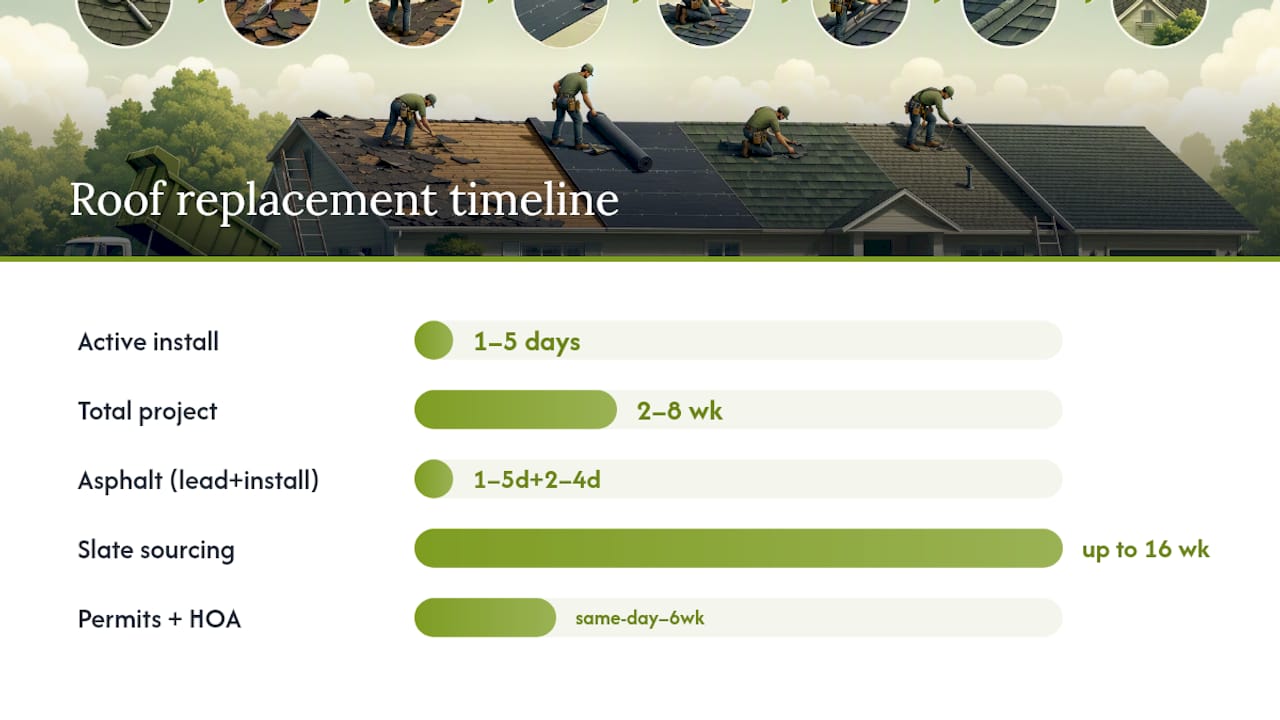
Table of Contents
- How the roof replacement timeline breaks down phase by phase
- How long does installation actually take by material type?
- What factors can lengthen or shorten your schedule?
- Permits, insurance, and the contractor checklist
- What you should do before and during installation
- How roof age and condition change your planning window
- How Sladeroof manages a replacement from start to finish
- What experienced roofers wish homeowners understood about scheduling
- Sladeroof delivers a predictable schedule with insurance support built in
- Sources
How the roof replacement timeline breaks down phase by phase
The day-by-day breakdown shows that installation is rarely the bottleneck. The phases before and after it are where calendar time quietly accumulates.
| Phase | Typical Duration | What drives variance |
|---|---|---|
| Inspection & estimate | 1–3 days | Contractor availability, roof access |
| Contractor selection | 3–7 days | Number of bids, reference checks |
| Contract & material ordering | 3–14 days | Material type, supplier stock |
| Permits & HOA approvals | 1–3 weeks | Municipality, HOA review cycles |
| Scheduling & pre-install prep | 3–7 days | Crew availability, season |
| Active installation | 1–5 days | Material, roof size, crew size |
| Final inspection & walkthrough | 1–3 days | Inspector availability |
For a 2,000 sq ft asphalt roof, the realistic milestones look like this:
- Day 1–2: Inspection and written estimate
- Day 3–7: Review bids, check credentials, sign contract
- Day 8–14: Materials ordered; permit application submitted
- Week 2–4: Permit approved; HOA sign-off received (if applicable)
- Week 3–5: Crew scheduled; pre-install site prep confirmed
- Week 4–6: Active installation (tear-off, decking, underlayment, shingles, cleanup)
- Week 5–7: Final inspection and walkthrough
Pro Tip: Submit your HOA application and permit paperwork the same week you sign the contract. Homeowners who front-load this step routinely shave one to two weeks off the total calendar.
How long does installation actually take by material type?
The “3-day job” your neighbor mentions almost certainly involved asphalt shingles. Switch to metal panels or natural slate and that number changes significantly. Active installation-day ranges by material on a typical single-family home:
- Asphalt shingles: 2–4 days. The fastest option. Lightweight, widely available, and most crews install them daily.
- Standing-seam metal: 4–7 days. Panels require precise measuring and field fabrication. Mistakes are expensive, so crews move deliberately.
- Concrete tile: 5–8 days. Heavy material demands reinforced decking checks and careful hand-placement.
- Clay tile: 6–10 days. Similar to concrete but more fragile during handling, which slows the pace.
- Natural slate: 7–14 days. Each piece is hand-fitted and nailed individually. A skilled slate crew is also harder to find, which affects scheduling before the job even starts.
| Material | Active Install Days | Lead Time for Materials |
|---|---|---|
| Asphalt shingles | 2–4 | 1–5 business days |
| Standing-seam metal | 4–7 | 2–6+ weeks |
| Concrete tile | 5–8 | 2–8 weeks |
| Clay tile | 6–10 | 4–16 weeks |
| Natural slate | 7–14 | 4–16 weeks |
Crew size matters too. A four-person crew on a 1,500 sq ft asphalt roof can finish in a single long day. That same roof with a two-person crew takes two to three days. For larger homes above 3,000 sq ft, add at least one day per material category above.
What factors can lengthen or shorten your schedule?
Some of these you control. Most you do not, but you can plan around them.
-
Weather. Rain, high winds, and temperatures below 40°F can halt or delay installation. A week of storms mid-project can push completion by 5–7 days. Scheduling in late spring or early fall reduces this risk. For winter-specific planning, Sladeroof’s cold-weather roofing guidance covers what to expect.
-
Roof complexity and pitch. A steeply pitched roof with multiple valleys, dormers, or skylights takes longer than a simple gable. Expect 20–40% more installation time on complex geometry versus a flat or low-slope surface.
-
Decking damage. Rotten or damaged sheathing discovered during tear-off adds 1–2 days minimum and requires a change order. This is the most common source of mid-project delays. Ask your contractor upfront what the per-sheet decking replacement cost is so you are not surprised.
-
Material lead times. Standard asphalt shingles arrive in 1–5 business days. Custom metal panels or specialty tile can take 2–16 weeks depending on color and stock. Ordering before the permit is approved is a calculated risk that many experienced contractors take to compress the calendar.
-
Permit and HOA delays. Some municipalities issue over-the-counter permits the same day. Others require a 2–4 week plan review. HOA approvals often add another 1–2 weeks on top of that. Knowing your local permit office’s current processing time before you sign a contract is worth a five-minute phone call.
-
Contractor scheduling and seasonal demand. Summer is peak season. A contractor who can start in two weeks in March may have a six-week backlog in July. Booking in late winter or early spring, as Sladeroof’s spring scheduling guide explains, often secures better crew availability.
-
Site access and logistics. A home with a narrow driveway, overhead power lines, or limited staging space slows material delivery and dumpster placement. Flag these constraints during the estimate so the crew arrives prepared.
Permits, insurance, and the contractor checklist
Permits are not optional on a full replacement in most U.S. jurisdictions. Skipping one can void your homeowner’s insurance coverage and create problems at resale. Processing times range from same-day over-the-counter approvals to a 2–4 week formal review, depending on your municipality.
Insurance claims add their own sequence. After you file, an adjuster typically inspects within 5–10 business days. The written estimate and approval can take another 1–2 weeks. Only after that approval can most contractors order materials or schedule a start date. That sequence alone can add 3–4 weeks to your calendar before a nail is driven.
A professional roof survey that produces permit-ready measurements and photos can cut the back-and-forth with both the permit office and your insurer, sometimes by a week or more.
Questions to ask every contractor before signing:
- How long does your permit application typically take in this municipality?
- Do you handle permit filing, or is that my responsibility?
- Can you order materials before the permit is approved to compress the schedule?
- How do you handle decking damage discovered during tear-off?
- Do you have experience coordinating with insurance adjusters?
- What is your current crew availability and estimated start date?
- Who is my point of contact during the project, and how often will you update me?
Vetting a contractor’s track record matters as much as their price. Checking credentials and business standing, including licensing, insurance certificates, and reviews, helps avoid scheduling headaches tied to underperforming crews.
Pro Tip: Ask for a good roofer checklist before your first contractor meeting. Walking in with specific questions about permits, crew allocation, and insurance support separates serious contractors from those who will leave you guessing.
What you should do before and during installation
The homeowner’s prep list is short, but skipping any item on it reliably causes delays.
Before the crew arrives:
- Finalize your material and color selection before signing the contract. Changes after ordering restart the lead-time clock.
- Clear vehicles from the driveway and any area within 15 feet of the house.
- Move patio furniture, potted plants, and outdoor decor away from the work perimeter.
- Confirm your HOA application is submitted and approved before the scheduled start date.
- Notify neighbors. Roofing is loud and starts early, often by 7 AM.
- Secure or relocate pets. Crew members moving in and out of gates create escape opportunities.
- Protect attic contents. Vibration from nail guns shakes dust and debris loose.
On installation day:
- Keep a clear 10–15 ft perimeter around the house for material staging and dumpster placement.
- Do not plan to work from home without noise-canceling headphones. A full crew on a roof is genuinely loud.
- Confirm with the crew lead where they will park and whether the dumpster placement works for your property.
- After the job, walk the yard with a magnetic nail sweeper before children or pets go outside. Stray nails are the most common post-job complaint.
Pro Tip: Ask your contractor to do a magnetic sweep of the yard and driveway as part of the final cleanup. Most professional crews include this, but confirming it upfront means you do not have to ask twice.
How roof age and condition change your planning window
The decision between repair and replacement directly affects how much calendar time you need to block off. Repairs typically take hours to a couple of days. A full replacement adds weeks for permitting, material ordering, and scheduling.
Use these criteria to guide the decision:
- Age: Most asphalt shingle roofs last about 20–25 years. If yours is past 20 years and showing visible wear, plan for replacement rather than waiting for a leak.
- Damage extent: If more than 30% of the surface is damaged or missing, repair costs approach replacement costs quickly.
- The 25% rule: GAF’s industry guidance puts it plainly: if a repair quote approaches 25% of a full replacement cost, replacement is usually the smarter financial move.
- Recurring repairs: Two or more repairs in three years on the same area is a reliable signal the underlying structure is failing.
Emergency replacements compress decision time but almost always stretch the calendar. Insurance adjusters are busier after storm events, permit offices see higher volume, and contractors are booked. A roof replaced on a planned schedule, before the failure point, typically completes two to three weeks faster than one triggered by an active leak or storm damage.
A fall inspection before storm season is one of the most practical ways to catch deterioration early and replace on your terms rather than the weather’s.
How Sladeroof manages a replacement from start to finish
Sladeroof’s process is built around one thing most homeowners say they want most: a firm schedule they can actually count on. Here is how a standard asphalt replacement typically moves through the calendar with Sladeroof as the contractor:
- Week 1: On-site inspection, written estimate, and insurance coordination if a claim is involved. Sladeroof’s team handles adjuster communication directly, which removes the most common source of approval delays.
- Week 1–2: Contract signed, materials ordered, permit application filed. For standard asphalt, materials arrive within 1–5 business days.
- Week 2–3: Permit approved, crew scheduled. Sladeroof confirms a start date in writing.
- Week 3–4: Active installation. Tear-off, decking inspection and repair if needed, underlayment, shingles, flashing, ridge cap, and full cleanup including a magnetic nail sweep.
- Week 4: Final walkthrough, documentation provided, warranty registered.
Sladeroof backs its work with a 25-year leak warranty and a 50-year product warranty. Impact-resistant materials are standard on qualifying installs, which can lower insurance premiums and reduce future claim exposure. For homeowners in Idaho, Arizona, and Wyoming, that combination of verified installation quality and insurance-side expertise is what separates a roof that just covers the house from one that actively protects it.
What experienced roofers wish homeowners understood about scheduling
Most timeline disputes between homeowners and contractors trace back to one misunderstanding: the difference between active install days and total calendar time. A contractor who says “three days” means three days of crew on your roof, not three days from your first call to a finished project.
The homeowners who have the smoothest experiences are the ones who ask two questions early: “What is your current permit timeline in my area?” and “What is your crew’s earliest available start date?” Those two answers define the realistic calendar window better than any estimate sheet.
Communication frequency matters too. A weekly check-in with your contractor during the permit and ordering phase, even a brief text exchange, catches problems before they become delays. If materials are backordered or the permit office requests revisions, you want to know on day three, not day seventeen.
One job that stretched unexpectedly: a homeowner in a mountain-zone municipality where the permit office required a structural engineer’s sign-off on the decking load for a tile upgrade. Nobody flagged it at estimate time. The fix was straightforward once identified, but it added 12 days to the calendar. The lesson is not that tile is risky. It is that asking “are there any jurisdiction-specific requirements for this material?” at the estimate stage costs nothing and can save weeks.
Sladeroof delivers a predictable schedule with insurance support built in
Homeowners who have been through a roof replacement once know the frustration of a moving start date and an insurer who seems to be working on a different calendar entirely. Sladeroof was built specifically to solve both problems.

With over 20 years of combined roofing and insurance expertise, Sladeroof handles permit filing, adjuster coordination, and material ordering as part of every project, not as add-ons. The result is a tighter calendar with fewer surprises. Services available across Idaho, Arizona, and Wyoming include:
- Full residential roof replacements with impact-resistant and weather-rated materials
- Insurance claim coordination from first inspection through final approval
- Emergency repair response when waiting is not an option
- Eco-conscious roofing options for homeowners prioritizing sustainability
The 25-year leak warranty and 50-year product warranty are not marketing language. They are the reason Sladeroof’s installs are engineered rather than simply installed. Get a firm estimate and a realistic start date by visiting Sladeroof’s residential roofing services page, or explore the full range of options at Sladeroof.
Sources
- Bestroofingcalculators
- Roof Replacement Timeline (Day-by-Day Guide for 2026)
- How Long Does a Roof Replacement Take? Real 2026 Timeline | The Roofing Brief
- How to Know When It’s Time to Replace Your Roof - HouzzWire
- Understanding residential roof repairs: How do I know if my roof needs to be replaced | GAF
Recommended
Ready for a real answer on your roof?
Slade Roofing pairs licensed insurance agents with licensed roofers. Get your free inspection in about 30 seconds.
Get My Free Inspection →