Does Adding Solar Panels Void Your Roof Warranty?
In most cases, no. Installing solar panels does not automatically void a roof manufacturer’s product warranty if the installer follows manufacturer specs and uses approved attachment methods. But “in most cases” is doing real work in that sentence, and skipping the paperwork is how homeowners lose coverage they thought they still had.
Before anyone climbs on your roof, do three things:
- Contact your roof manufacturer directly and ask about their solar policy.
- Require written approval or a compliance document before installation starts.
- Hire a certified installer and photograph everything before, during, and after.
Pro Tip: Keep a folder, physical or digital, with your roof manufacturer’s warranty terms, your solar installer’s workmanship warranty, and every email exchange about compliance. You will want this the day something goes wrong, not the day after.
Key Takeaways
Solar installations preserve roof warranty coverage when installers use manufacturer-approved methods, obtain written compliance documentation, and document the work with photos and inspection records.
| Point | Details |
|---|---|
| Solar rarely voids roofs alone | Proper installation following manufacturer specs typically preserves your roof warranty. |
| Three separate warranties exist | Product, performance, and workmanship warranties each cover different failures and different timeframes. |
| Compliance paperwork matters most | A Letter of Compliance and post-install inspection are what manufacturers actually check during a claim. |
| Document everything before and after | Photos, invoices, and installer credentials resolve disputes faster than memory ever will. |
| Sladeroof coordinates both warranties | A single contractor handling roof inspection and solar coordination reduces the risk of denied claims. |
Table of Contents
- The Three Warranties You’re Actually Dealing With
- Does Solar Installation Really Void Your Roof Warranty?
- Your Pre-Install Checklist for Protecting Roof Warranty Coverage
- How Long Do These Warranties Last, and Do They Transfer?
- Exclusions and Red Flags That Actually Cost You Coverage
- If Your Roof Leaks After Solar Installation
- What Real Manufacturer Warranty Language Looks Like
- Why Warranty Paperwork Deserves a Line in Your Solar Budget
- Protect Your Roof Warranty Before Solar Goes Up
- Where to Verify Warranty Details Yourself
- Frequently Asked Questions
- Sources
The Three Warranties You’re Actually Dealing With
Nobody sits you down before a solar install and explains that you’re now juggling three separate warranties from three separate parties. That gap causes most of the confusion homeowners run into later.
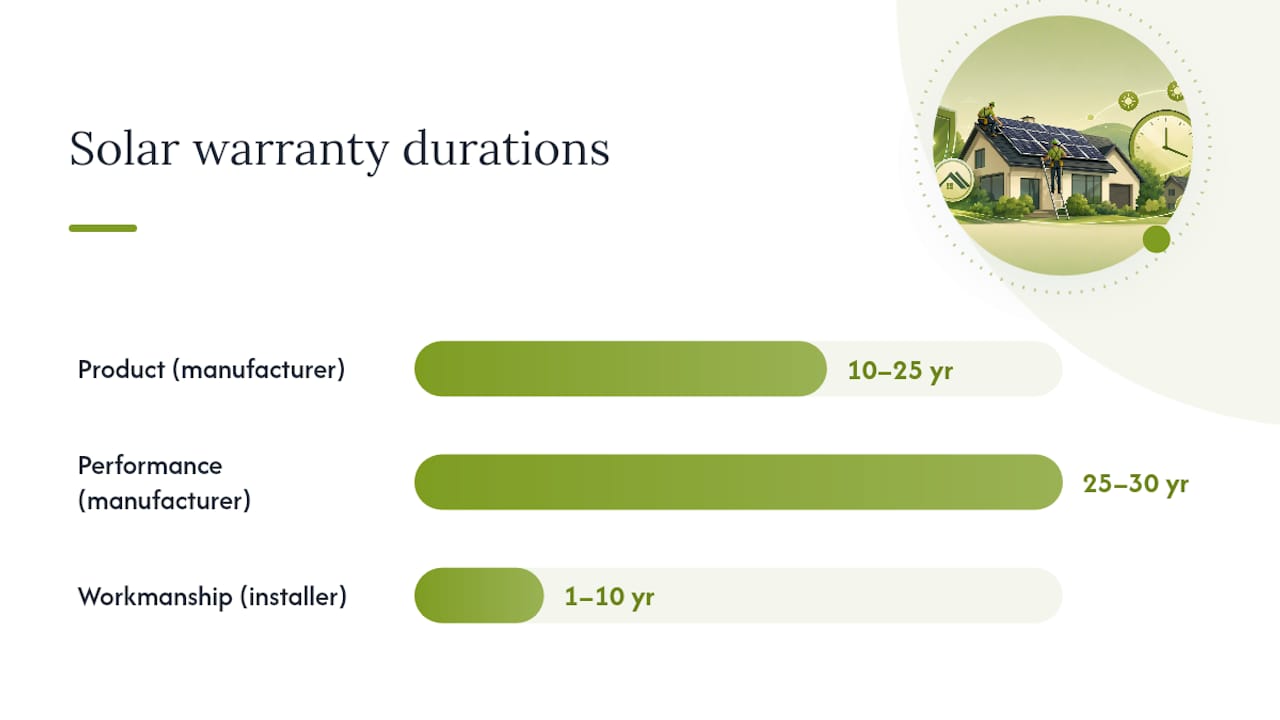
The product warranty (sometimes called an equipment warranty) comes from the panel manufacturer and covers manufacturing defects. It typically runs 10 to 25 years, and it has nothing to do with your roof. If a panel fails because of a factory flaw, this is who you call.
The performance warranty guarantees output over time. Most run 25 to 30 years, and the industry standard guarantees panels will still produce at least 80% of their rated output after 25 years. This one is about energy production, not physical damage.
The workmanship warranty, sometimes called an installation warranty, comes from whoever physically installed the system. It typically runs 1 to 10 years and covers installer errors: bad flashing, sloppy penetrations, mounts that were never sealed correctly. This is the warranty most closely tied to your roof’s health, and it is also the shortest one on the list.
- Product warranty issues: contact the panel manufacturer.
- Performance warranty issues: contact the panel manufacturer or your monitoring provider.
- Workmanship warranty issues: contact your solar installer.
- Roof damage claims: contact your roofing manufacturer and roofing contractor.
Your roof’s own manufacturer warranty sits separately from all three, and it is the one solar installers touch the least but affect the most.
Does Solar Installation Really Void Your Roof Warranty?
Here’s the direct answer: installing solar panels does not automatically void most roof manufacturer product warranties, provided the installer follows the manufacturer’s specifications and approved attachment methods. The Asphalt Roofing Manufacturers Association has said as much in its own technical guidance: properly installed PV systems that follow attachment and flashing recommendations should not void a shingle warranty on their own.
What actually voids coverage isn’t the presence of solar panels. It’s how they get attached.
- Improper roof penetrations that aren’t sealed to manufacturer standards
- Incorrect or missing flashing around mounting points
- Non-approved mounting hardware or brackets
- Physical damage caused during panel installation or removal
Some manufacturers have formalized the process to prevent disputes later. Carlisle, for example, requires installers to submit a PV Letter of Compliance and a roof plan before work begins, and it mandates a post-installation inspection with a fee of $0.05 per square foot and a $750 minimum on qualifying projects. That inspection isn’t bureaucratic overhead. It’s the manufacturer’s way of confirming the installer used compatible anchors and didn’t compromise the membrane.
Most manufacturer warranty language draws a hard line between defects in the roofing material itself and damage caused by outside contractors. Read the fine print and you’ll typically find something to this effect:
Coverage applies to defects in materials and workmanship performed by an authorized applicator. Damage resulting from alterations, third-party installations, or unauthorized penetrations is excluded from this warranty.
That distinction, defect versus damage caused by someone else’s work, is exactly why the solar installer’s credentials matter as much as the panels they’re selling you.
Your Pre-Install Checklist for Protecting Roof Warranty Coverage
Treat this like a sequence, not a suggestion list. Skipping step one makes every later step harder to fix.
- Call your roof manufacturer and ask about their specific solar installation policy.
- Request written approval, a Letter of Compliance, or equivalent documentation before signing anything.
- Confirm your roof’s remaining warranty term. If it’s close to expiring, consider re-roofing first.
- Vet your solar and roofing contractors separately if they aren’t the same company.
- Get the compliance letter, roof plan, and inspection scheduled before panels go up.
- Save every document, photo, and invoice in one place.
Before signing a contract, insist on these items in writing:
- Manufacturer approval or a formal Letter of Compliance
- Confirmation of approved flashing and mounting hardware
- A written workmanship warranty with a specific term length
- Clear terms for panel removal and reinstallation (for future re-roofing)
- Proof of liability insurance and, ideally, NABCEP-certified installers
Ask every contractor bidding on the job: Are you credentialed with my roofing manufacturer? Will you use flashing the manufacturer specifically approves? Do you carry liability and professional indemnity coverage? A contractor who hesitates on any of these questions just told you something important.
How Long Do These Warranties Last, and Do They Transfer?
Product warranties on panels usually run 10 to 25 years. Performance warranties typically stretch 25 to 30 years. Workmanship warranties from the installer are the shortest, often just 1 to 10 years, which means your weakest link in coverage tends to expire decades before your panels stop producing power.
Most manufacturer product and performance warranties transfer to a new homeowner if you sell the house, though many require formal registration and some charge a transfer fee. Workmanship warranties are less consistent. Some installers honor them for new owners automatically; others require a transfer request within a set window after the sale closes.
- Check whether your solar installer’s warranty is transferable and what the deadline is.
- Ask your roofing manufacturer whether their post-install inspection requirement has a time limit.
- Keep your Letter of Compliance and inspection records with the house’s paperwork, not just your own files.
Seasonal maintenance can also factor into whether a roofing manufacturer considers a warranty claim valid years down the road.
Exclusions and Red Flags That Actually Cost You Coverage
Most voided warranty claims trace back to a handful of repeatable mistakes:
- Physical damage the installer caused while walking, drilling, or mounting equipment
- Attachment methods or brackets the roofing manufacturer never approved
- Flashing installed incorrectly or skipped altogether
- Roof work performed later by a contractor with no manufacturer credentials
- Cosmetic damage exclusions that let a manufacturer deny a claim that looks minor but isn’t
Watch for these signs before you sign anything: vague workmanship language with no specific term length, refusal to produce compliance paperwork, no evidence the mounts are manufacturer-approved, or no proof of insurance. If you spot any of these mid-project, stop work, photograph the current state of the roof, and put your concerns in writing to the contractor immediately.
If Your Roof Leaks After Solar Installation
Stop any further work on the roof and don’t let anyone patch it before it’s documented. Notify both your solar installer and your roofing manufacturer the same day you notice the problem. Photograph the damage from multiple angles, then schedule an inspection with a qualified roofer.
- Photograph the leak or damage before anyone touches it.
- Pull your pre-install and post-install inspection reports.
- Gather your Letter of Compliance, installer invoices, and credentials.
- Contact whichever party is responsible based on the damage type.
If the leak traces back to installer error, that’s a workmanship claim against the solar contractor. If it’s a material defect unrelated to the installation, that’s a manufacturer product claim. If storm damage happened afterward and coincidentally near the panels, your homeowner’s insurance may need to get involved, which is where clean documentation saves you weeks of back-and-forth.
What Real Manufacturer Warranty Language Looks Like
Tesla’s warranty for its photovoltaic modules is a useful example because it draws such a clean line between categories. It covers module defects for 25 years and separately guarantees performance decline rates, but it explicitly excludes installer workmanship and materials supplied by anyone other than Tesla.
Product coverage extends to defects in materials and manufacturing. It does not extend to damage resulting from improper installation, unauthorized modification, or the use of components not supplied or approved by the manufacturer.
Beyond the panel manufacturer’s own paperwork, some homeowners add supplemental coverage. Solar Insure is one example of a third-party warranty provider covering parts and labor beyond what the original manufacturer includes, useful if you want protection that doesn’t depend on tracking down the original installer years later. Equipment brands like Enphase and SolarEdge also publish their own detailed warranty PDFs worth reading before you sign anything. Search for terms like “product warranty,” “performance guarantee,” and “workmanship exclusions” inside those documents. The exclusions section is where the real answers live.
How a Roofer Who Understands Solar Protects Both Warranties
A roofer experienced with solar coordinates directly with your solar installer before anyone touches shingles or membrane. That means a pre-install roof inspection, manufacturer-approved mounts and flashing, and signed documentation once the work is done.
- Pre-install inspection to confirm roof condition and remaining warranty life
- Coordination with the solar installer on approved attachment points
- Post-install photos and paperwork filed for both warranties
A single contractor handling roof and coordination eliminates the finger-pointing that happens when a roof leaks and two companies both blame the other.
Pro Tip: If your roofer and solar installer are different companies, ask them to email each other directly about attachment specs before install day. Don’t be the middleman relaying technical details by phone.
Why Warranty Paperwork Deserves a Line in Your Solar Budget
Homeowners budget for panels, inverters, and labor. Few budget for the inspection fees, compliance letters, and possible rework a manufacturer might require. Skip that step and you’re not saving money. You’re deferring a bill that might come due as a denied claim years later, usually right when a leak shows up.
Build in a few hundred dollars for compliance documentation and inspection costs, the same way you’d budget for permits. It’s cheap insurance against a much bigger expense.
Protect Your Roof Warranty Before Solar Goes Up
Coordinating a roof warranty with a solar install shouldn’t fall entirely on you to figure out. Sladeroof inspects your roof before any solar work begins, coordinates directly with your solar installer on manufacturer-approved mounts and flashing, and documents every step so both your roofing and workmanship warranties stay intact.
That means one point of contact instead of two companies pointing fingers if something goes wrong later, backed by a written workmanship warranty on the roofing side. If you’re planning solar and want your roof protected before installers show up, request a professional roof inspection and get a clear picture of what your roof needs first.
Where to Verify Warranty Details Yourself
Don’t take a contractor’s word for it. Pull the primary documents and read the exclusions section yourself.
- Your roof manufacturer’s technical bulletins and warranty PDF
- Carlisle’s PV Letter of Compliance procedure, if applicable to your roof system
- Industry guidance from the Asphalt Roofing Manufacturers Association or the Tile Roofing Institute if you have a tile roof
- Your solar panel manufacturer’s specific warranty document (Tesla, Enphase, SolarEdge)
Every manufacturer’s exclusions section reads a little differently, so read your own before you assume you’re covered.
Frequently Asked Questions
Does installing solar panels always require notifying my roof manufacturer?
Most manufacturers expect notification, and some require formal written approval before installation. Skipping this step doesn’t guarantee a voided warranty, but it removes your ability to prove compliance if a dispute comes up later.
How long does a typical solar panel roof warranty last?
Product warranties usually run 10 to 25 years, performance warranties run 25 to 30 years, and workmanship warranties typically run 1 to 10 years depending on the installer.
Can I transfer my roof and solar warranties when I sell my house?
Many manufacturer product and performance warranties transfer with proper registration, sometimes for a fee. Workmanship warranties vary by installer, so check the specific terms before closing.
What’s the difference between a roofing warranty for solar panels and a standard roof warranty?
A standard roof warranty covers the roofing material itself. Once solar goes up, you’re also relying on the installer’s workmanship warranty to cover anything related to mounts, flashing, and penetrations they added.
Who pays if my roof leaks after solar panels are installed?
It depends on the cause. Installer error falls under the workmanship warranty, a material defect falls under the roof manufacturer’s product warranty, and storm-related damage may involve your homeowner’s insurance.
Sources
- Homeowner’s guide to solar system warranty coverage
- TESLA PHOTOVOLTAIC MODULE LIMITED WARRANTY (USA)
- Photovoltaic systems and asphalt shingle roofs (Asphalt Roofing Manufacturers Association)
- Warranties Needed For Rooftop Solar Panels (Atlas Roofing)
Recommended
Ready for a real answer on your roof?
Slade Roofing pairs licensed insurance agents with licensed roofers. Get your free inspection in about 30 seconds.
Get My Free Inspection →