TPO vs EPDM: Which Flat Roof Should You Pick?
For most cooling-dominated commercial roofs, TPO is the stronger call. For cold climates, long hold periods, or budget-first projects, EPDM usually wins on lifecycle value. Neither membrane is universally better — the right answer depends on three things: your climate, how long you plan to own the building, and the quality of the crew doing the install.
Three situational rules that settle most decisions:
- Climate first. White TPO’s high solar reflectance reduces cooling loads substantially in hot climates, while black EPDM absorbs heat, which can be advantageous in colder climates.
- Hold period and lifecycle target. EPDM has a longer documented field life. Many EPDM roofs remain watertight at 30–40 years; heavy-gauge sheets can push past 40. If you’re planning a 10-year hold and then selling, TPO’s lower upfront cost and energy savings may pencil out better.
- Rooftop geometry and equipment. A roof with HVAC units, curbs, and regular foot traffic needs at least 60 mil — ideally 80 mil. Thicker membrane and a fully adhered attachment method matter more than brand name on a busy equipment roof.
One more thing: workmanship and membrane thickness determine final performance more than chemistry alone. A perfectly specified TPO job done by an undertrained crew will fail before a 45-mil EPDM job done by a certified installer.
Table of Contents
- How do TPO and EPDM compare side by side?
- What TPO is and how it behaves in the field
- What EPDM is and how it behaves in the field
- How do these membranes hold up against real stressors?
- Energy performance and climate suitability
- How installation method and installer skill change outcomes
- What does a TPO or EPDM roof actually cost, and how long will it last?
- What questions should you ask before choosing a membrane?
- How can you tell whether your current roof is TPO or EPDM?
- Key Takeaways
- What the membrane debate usually gets wrong
- What the membrane debate usually gets wrong
- Sladeroof installs both membranes — here’s what to expect
- Sources and further reading
How do TPO and EPDM compare side by side?
| Attribute | TPO | EPDM |
|---|---|---|
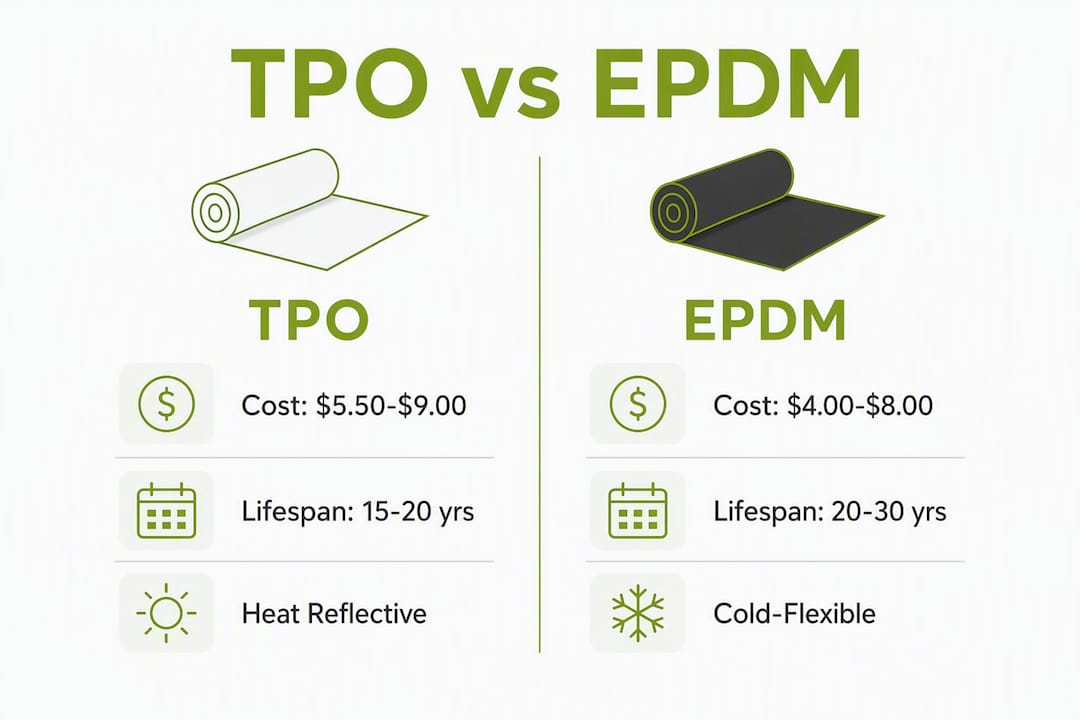
| TPO typically installs for $5.50–$9.00 per square foot, while EPDM commonly installs for $4.00–$8.00 per square foot, with EPDM usually costing less. | ||
| TPO service life is typically 20–30 years depending on thickness and install quality; EPDM often lasts 25–40+ years when well-installed. | ||
| Seam type | Heat-welded (monolithic) | Adhesive/tape |
| Seam strength | High when properly welded | Dependent on prep and primer |
| SRI (reflectivity) | 78–99 (white) | ~6 (black); white EPDM available |
| Ponding water tolerance | Moderate; prolonged ponding degrades seams | Good; rubber tolerates standing water |
| Puncture resistance | Moderate (improves significantly at 60–80 mil) | Good; rubber absorbs impact |
| Cold-weather flexibility | Stiffens below ~40°F; installation constraints | Stays flexible in sub-zero temps |
| Typical warranty | 15–30 year NDL (manufacturer-dependent) | 10–30 year NDL |
| Best climate/use-case | Cooling-dominated climates; energy-conscious owners | Cold climates; long-hold or budget projects |
The two factors that decide most real-world choices: climate zone (cooling vs heating dominated) and how long the owner plans to hold the asset. Everything else is secondary.
What TPO is and how it behaves in the field
TPO stands for thermoplastic polyolefin, a single-ply membrane made from a blend of polypropylene and ethylene-propylene rubber. The thermoplastic chemistry is the key detail: unlike rubber, TPO can be re-melted, which is exactly what makes hot-air welded seams possible. A properly executed weld fuses two sheets into a single monolithic joint that is often stronger than the membrane itself.
Common thicknesses and what they mean in practice:
- 45 mil — the entry spec; acceptable for simple low-traffic roofs but leaves little margin for puncture or long-term UV exposure.
- 60 mil — the practical minimum for most commercial applications; noticeably better puncture resistance and a longer expected service life.
- 80–90 mil — specified for equipment-heavy roofs, high-traffic surfaces, or owners targeting a 25–30 year service life with confidence.
TPO’s reflectivity is its headline advantage. White membranes consistently achieve SRI values of 78–99, which qualifies them for CRRC (Cool Roof Rating Council) listings and Energy Star certification on most products. That matters for utility rebates and building code compliance in many jurisdictions.
The honest limitation: early-generation TPO formulations from the late 1990s and early 2000s suffered heat-aging failures and weld-line delamination. Modern formulations have been substantially re-engineered, but TPO’s service life is still more variable than EPDM’s. The fix is specifying the right thickness and confirming the manufacturer’s heat-aging test data (ASTM D6878 is the relevant standard) before signing off on a spec.
When reviewing a TPO spec sheet, check for: CRRC listing number, ASTM D6878 compliance, heat-aging test results at 240°F, and whether the manufacturer requires certified installers to activate the full warranty.
What EPDM is and how it behaves in the field
EPDM — ethylene propylene diene monomer — is a thermoset synthetic rubber. Thermoset means it cannot be re-melted once cured, which is why seams rely on contact adhesives, seam tape, or a combination of both rather than heat welding. That distinction drives most of the practical differences between the two membranes.
Common thicknesses:
- 45 mil — budget installs; adequate for simple, low-traffic roofs with good drainage.
- 60 mil — the commercial standard; better impact resistance and longer expected life.
- 75–90 mil — specified for owners targeting 35–40+ year service life; heavy-gauge EPDM has the longest documented field life of any single-ply membrane.
EPDM’s cold-weather flexibility is a genuine advantage. The rubber stays pliable at sub-zero temperatures, which matters both for installation in cold climates and for long-term performance through freeze-thaw cycles. That’s one reason EPDM still dominates retrofit and re-roofing work in the northern US.
The seam is EPDM’s Achilles’ heel. Adhesive and tape seams are sensitive to surface contamination, temperature at time of application, and primer selection. Field failures are most commonly seam-related when installation practice is poor — not a membrane failure, but a workmanship failure that looks like one.
The single most important spec decision for EPDM is seam system selection. Specify the seam tape manufacturer, primer product, and application temperature range in the contract documents — not just “EPDM 60 mil.” Vague specs invite shortcuts.
Pro Tip: Ask any EPDM bidder to name the specific seam tape and primer they plan to use, and confirm those products are approved by the membrane manufacturer. Mismatched adhesive systems void warranties and fail early.
For weathering and ozone resistance, reference ASTM D4637 (EPDM sheet standard) and confirm the installer holds current manufacturer certification — most major EPDM manufacturers require it to activate NDL warranty coverage.
How do these membranes hold up against real stressors?
Most commercial roof failures trace back to four stressors: punctures, ponding water, wind uplift, and cold-weather movement. TPO and EPDM respond differently to each.
Puncture and hail resistance. EPDM’s rubber chemistry absorbs impact better than TPO at equivalent thickness. A 60-mil EPDM sheet will typically outperform a 45-mil TPO sheet on a hail strike. However, specifying 60 mil or heavier for roofs with rooftop equipment or frequent foot traffic closes that gap considerably. At 80 mil, TPO is competitive.
Ponding water. EPDM tolerates standing water better. TPO seams, particularly at penetrations and field laps, can degrade with prolonged ponding if the weld quality is marginal. That said, no membrane is a substitute for proper slope and drainage. A roof that ponds consistently will fail regardless of membrane type — fix the drainage first.
Wind uplift. Heat-welded TPO seams typically outperform adhesive EPDM seams under wind uplift when both are properly executed. Attachment method matters as much as seam type: fully adhered systems outperform mechanically attached on high-wind-exposure roofs, and ballasted systems are generally not appropriate above a certain wind zone.
Cold-weather flexibility. EPDM wins clearly. TPO stiffens below roughly 40°F, which creates installation constraints — welding parameters change, and membrane handling becomes more difficult. For cold-climate roofing, see Sladeroof’s cold-weather installation guidance for practical constraints on winter membrane work.

Pro Tip: Specify a minimum of 60 mil on any roof with rooftop HVAC equipment, solar racking, or regular maintenance foot traffic. The cost difference between 45 mil and 60 mil is small relative to the repair cost when a thinner sheet gets punctured by a dropped tool or a sharp equipment edge.
Energy performance and climate suitability
Reflectivity is where TPO earns its market-leading position in new commercial construction. White TPO membranes with SRI values of 78–99 can reduce roof surface temperatures by 50–80°F compared to black EPDM on a hot summer day. On a large commercial building in a cooling-dominated climate, that temperature difference translates directly into HVAC load reduction.
On a 100,000 sq ft warehouse in a hot climate, switching from black EPDM to white TPO can save an estimated $0.18–$0.32 per square foot per year in cooling costs — a figure that can offset TPO’s higher upfront cost within a few years of operation.
That math flips in cold climates. A warehouse in Minneapolis running a heating-dominated energy profile gets little benefit from a reflective roof — and black EPDM’s solar absorption can modestly reduce heating loads in winter. White EPDM is available and achieves comparable SRI to TPO, but it’s less common and typically costs more than standard black.
Climate-based guidance:
- Hot/cooling-dominated (Phoenix, Dallas, Boise summers): — White TPO’s energy savings justify the higher upfront cost in most cases. Check CRRC listings and local utility rebate programs before specifying.
- Cold/heating-dominated (Minneapolis, northern Idaho, Wyoming mountains): EPDM’s cold-flex performance and lower installed cost often make it the better lifecycle choice. Insulation assembly and roof geometry interact with reflectivity — a well-insulated roof reduces the energy advantage of either membrane.
For owners interested in sustainable roofing performance, Sladeroof covers energy-efficient roofing options that include cool-roof specifications for both residential and commercial projects.
How installation method and installer skill change outcomes
Workmanship is the single biggest variable in whether a TPO or EPDM roof reaches its expected service life. A well-specified membrane installed by an undertrained crew will underperform a modest spec installed by a certified, experienced one.
Seam failure modes by membrane type:
- TPO heat-welded seams fail when the welder is underpowered, the operator moves too fast, or the membrane surface is contaminated. The result is a “cold weld” — a seam that looks bonded but peels under uplift or thermal cycling. Cold welds are invisible to a casual inspection.
- EPDM adhesive/tape seams fail when primer is skipped, applied at the wrong temperature, or allowed to flash off too long before bonding. Seam tape applied over a dirty or wet surface will delaminate within a few seasons.
Attachment methods and when each fits:
- Fully adhered — membrane bonded directly to the insulation or substrate. Best wind-uplift resistance; required in high-wind zones and on roofs with complex geometry. Higher labor cost.
- Mechanically attached — membrane fastened through the insulation to the deck with plates and screws. Faster to install; acceptable for many commercial applications but creates stress points at fastener rows.
- Ballasted — membrane held down by stone or pavers. Lowest installed cost; not appropriate in high-wind zones or on roofs with slopes above roughly 2:12.
Pre-install checklist for owners vetting bids:
- Confirm the installer holds current manufacturer certification for the specific membrane being installed.
- Request factory training records or certification numbers — not just a verbal claim.
- Ask for detail drawings showing how penetrations, curbs, and drains will be flashed.
- Require a seam pull-test protocol in the contract (field seam tests at a specified frequency).
- Confirm warranty sequencing: the workmanship warranty and material warranty must align, not leave gaps.
- Ask for photographic documentation of substrate prep, seam completion, and penetration flashing as a warranty condition.
For a broader checklist on what to look for in a roofing contractor, Sladeroof’s guide covers credential checks and the right questions to ask before signing.
Pro Tip: Require field seam-pull test results in writing before final payment. A contractor who objects to pull testing is telling you something important about their confidence in the seam quality.
What does a TPO or EPDM roof actually cost, and how long will it last?
Installed cost varies by region, roof complexity, and membrane thickness. The ranges below reflect typical commercial installations in the US market.
| Spec | Installed cost ($/ft²) | Expected lifespan |
|---|---|---|
| TPO 45 mil | $5.50 | 15–20 years |
| TPO 60 mil | $5.50–$9.00 | 20–30 years |
| TPO 80 mil | $9.00 | 25–30 years |
| EPDM 45 mil | $4.00–$5.50 | 15–25 years |
| EPDM 60 mil | $4.00–$8.00 | 25–40+ years |
| EPDM 75–90 mil | $6.50–$8.00 | 40+ years |
TPO installed cost typically runs $5.50–$9.00 per square foot; EPDM commonly comes in at $4.00–$8.00 per square foot. Expected service life for properly installed TPO is typically 20–30 years, while EPDM in field installations often lasts 25–40+ years depending on thickness and maintenance. TPO is the volume leader in new commercial single-ply installs, while EPDM remains dominant in retrofits and budget-driven projects.
Warranty structures differ in ways that matter. TPO manufacturers typically offer 15–30 year no-dollar-limit (NDL) warranties that cover both material and labor — but only when a certified installer does the work and the spec meets minimum thickness requirements. EPDM NDL warranties run 10–30 years depending on manufacturer and thickness. Both types commonly exclude damage from ponding water, improper drainage, and unauthorized modifications.
Owners who choose on initial cost alone often pay more over the roof’s life. A 45-mil TPO job at $5.50/ft² that needs replacement in 15 years costs more per year of service than a 60-mil EPDM job at $6.50/ft² that runs 30 years. Run the math before accepting the low bid. Sladeroof’s commercial roof maintenance program is built around extending membrane life and catching problems before they become replacements.
What questions should you ask before choosing a membrane?
Work through this checklist in your first contractor meeting. It takes about 20 minutes and eliminates most bad decisions.
- Define your climate and energy goals — Is your building in a cooling-dominated or heating-dominated climate? Do you have utility rebates available for cool roofs? If cooling costs are significant, white TPO’s energy savings deserve a line in the lifecycle cost model.
How can you tell whether your current roof is TPO or EPDM?
Before bidding repairs or an overlay, you need to know what’s up there. Misidentifying the membrane leads to incompatible repair products and voided warranties.
Visual checks from the roof surface:
- Color. Most TPO is white or light gray. Most EPDM is black. (White EPDM exists but is uncommon; tan TPO exists but is rare.)
- Seam appearance. TPO seams are typically 4–6 inches wide with a smooth, slightly glossy weld line. EPDM seams show a lapped edge with visible tape or a bead of adhesive at the edge.
- Texture. TPO feels slightly harder and more plastic-like. EPDM feels rubbery and more pliable, especially in warm weather.
- Roll width. EPDM is commonly available in very wide sheets (10–50 feet), so fewer seams on a simple roof often indicate EPDM. TPO rolls are typically 10–12 feet wide.
Simple non-destructive checks:
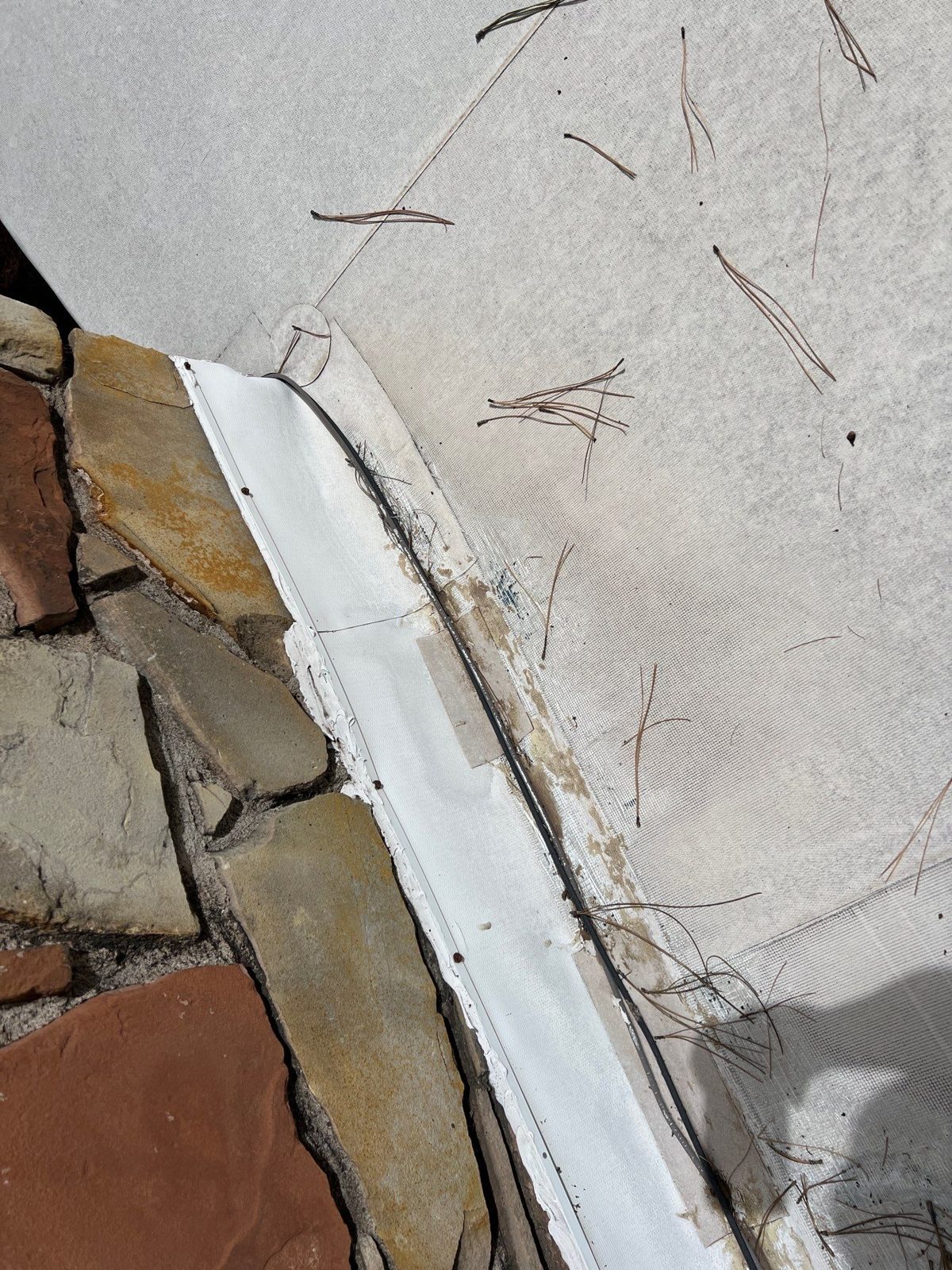
Look at a seam edge with a flashlight. A TPO weld will show a fused, continuous bond with no visible adhesive. An EPDM seam will show tape or dried contact cement at the lap edge. Check flashings at curbs and drains — EPDM flashings are typically black rubber; TPO flashings are typically white and heat-welded.
If the roof has been patched, look at the patch material. A white patch on a black field usually means someone applied TPO repair tape to an EPDM roof — a compatibility red flag.
Before authorizing any overlay or re-cover, get a moisture scan (infrared or nuclear) of the existing membrane. Trapping wet insulation under a new membrane accelerates deck deterioration and voids the new warranty. A scan costs a fraction of what a failed overlay costs to tear off.
Pro Tip: Always confirm membrane type in writing in the contract and spec documents before any repair or replacement work begins. “Existing single-ply membrane” is not a specification — it’s an invitation for the wrong repair product.
Key Takeaways
TPO wins on energy performance in hot climates; EPDM wins on cold-weather flexibility and long-term field life — but in both cases, membrane thickness and installer workmanship determine whether either membrane reaches its rated lifespan.
| Point | Details |
|---|---|
| Climate decides the first cut | White TPO (SRI 78–99) suits cooling-dominated climates; EPDM suits cold climates and long-hold projects. |
| Workmanship is the biggest variable | Cold welds on TPO and poor primer prep on EPDM cause most field failures — not the membrane chemistry itself. |
| Specify 60 mil minimum for commercial roofs | Equipment-heavy or high-traffic roofs need at least 60 mil; 80–90 mil extends service life past 25–30 years. |
| Lifecycle cost beats install price | EPDM at $4.00–$8.00/ft² with a 25–40+ year life often costs less per year of service than TPO at $5.50–$9.00/ft² with a 20–30 year lifespan. |
| Sladeroof for Idaho, Arizona, and Wyoming | Sladeroof installs and specifies both TPO and EPDM for commercial roofs, backed by a 25-year leak warranty and 50-year product warranty. |
What the membrane debate usually gets wrong
What the membrane debate usually gets wrong
Most TPO vs EPDM comparisons spend too much time on chemistry and not enough on the two things that actually determine whether a roof lasts: thickness and the crew doing the work.
The industry has a habit of treating membrane selection as the primary decision. It isn’t. A 45-mil TPO job on a roof with six HVAC curbs, installed by a crew without manufacturer certification, will fail faster than a 60-mil EPDM job installed by a team that has done 200 of them. The spec sheet matters. The installer matters more.
The other thing most comparisons understate is the energy savings case for TPO in hot climates. On a large commercial building in Phoenix or southern Idaho, the cooling cost reduction from a white membrane is real money — not a marketing claim. But that advantage disappears in a heating-dominated climate, and it also disappears if the insulation assembly is undersized. Reflectivity without adequate R-value is a partial solution.
One practical tip worth acting on before your next bid: ask every contractor for their last three seam pull-test results from comparable jobs. Most won’t have them. The ones who do are telling you exactly how seriously they take workmanship. That’s the contractor you want on your roof.
Sladeroof installs both membranes — here’s what to expect
When a commercial roof needs replacing in Idaho, Arizona, or Wyoming, the membrane choice is only half the decision. The other half is finding a contractor who will specify the right thickness, use manufacturer-certified crews, and back the work with a warranty that actually covers what can go wrong.

Sladeroof installs both TPO and EPDM for commercial properties, with a 25-year leak warranty and a 50-year product warranty on qualifying installations. Every project starts with a moisture scan and a written spec that names the membrane, thickness, seam system, and attachment method — not a vague “single-ply re-roof.” For equipment-heavy roofs, Sladeroof recommends 60 mil minimum and fully adhered attachment as the default, not an upgrade.
To get a site assessment and written specification for your commercial roof, contact Sladeroof through the commercial roofing services page. Bring your current roof drawings if you have them — the assessment covers moisture scanning, drainage review, and a warranty summary you can compare against any other bid.
Sources and further reading
- TPO vs EPDM Roofing Comparison | Roofs Wiki
- TPO vs EPDM Roofing: 2026 Commercial Comparison | The Roofing Brief
- Flat Roof Types 2026: TPO, EPDM, PVC, Mod-Bit, BUR | The Roofing Brief
- TPO vs EPDM Roofing: Pros, Cons & Best Uses for Each | Flat Roofing Insights
- Advanced Roof Membrane Systems and Extreme-Weather Resilience | WATERPROOF! Magazine
- Cool Roofs | U.S. Department of Energy
- ASTM D6878 Standard Specification for Thermoplastic Polyolefin Based Sheet Roofing | ASTM International
- ASTM D4637 Standard Specification for EPDM Sheet Used in Single-Ply Roof Membrane | ASTM International
Recommended
Ready for a real answer on your roof?
Slade Roofing pairs licensed insurance agents with licensed roofers. Get your free inspection in about 30 seconds.
Get My Free Inspection →